Product Knowledge Base
+
Valora Cuff — Complete Product Guide
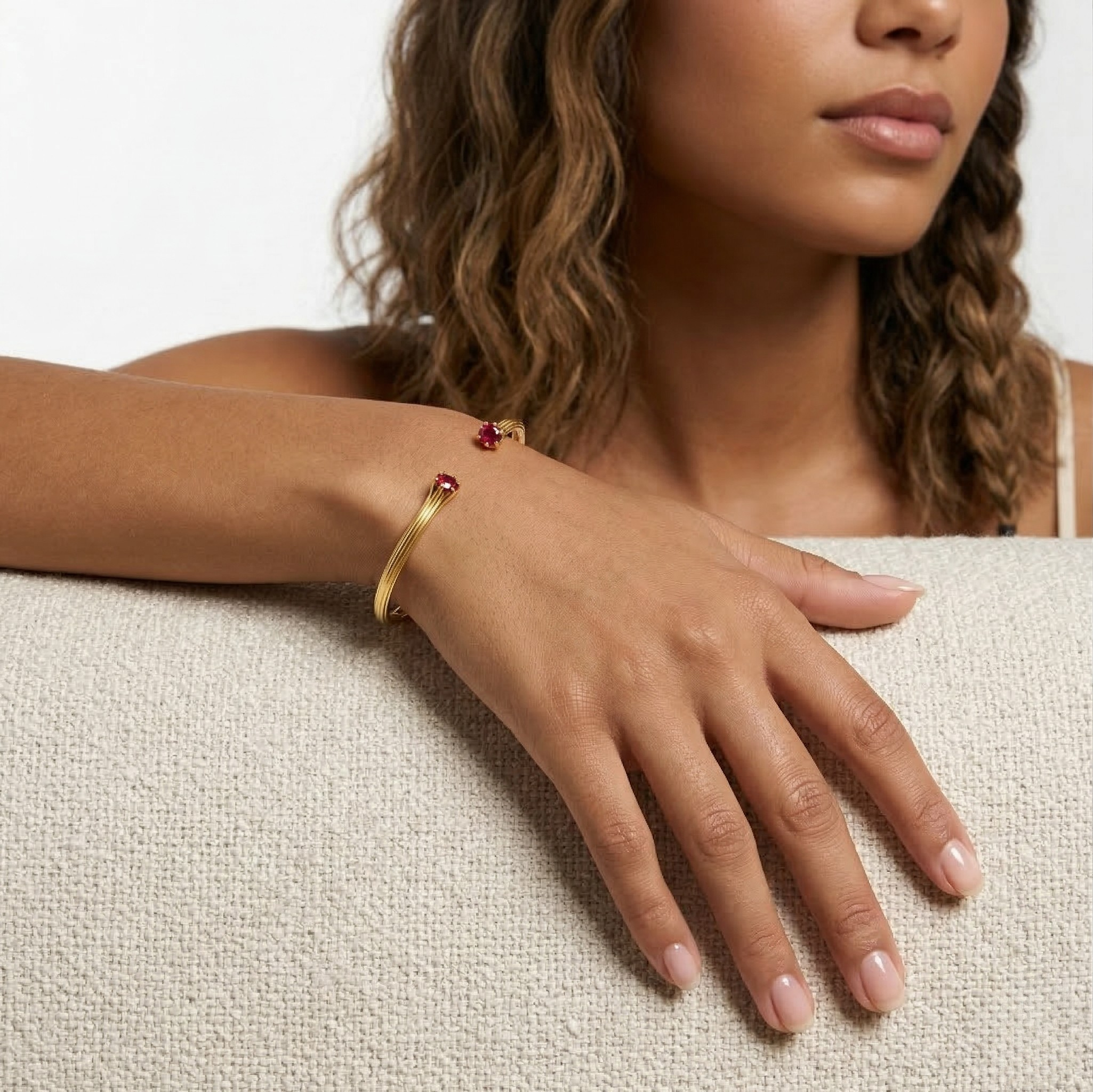
The Valora Cuff is a women’s sterling silver cuff bracelet with ember-red stone accents. A cuff belongs to the bracelet category, but it differs from chain bracelets, tennis bracelets, and bangles because it is typically a semi-rigid form with an opening that allows the piece to slide over the side of the wrist. Unlike a chain bracelet, it does not rely on interlocking links for flexibility; unlike a closed bangle, it has an open gap that can make sizing and removal easier.
The defining construction of this piece is its cuff format: a shaped sterling silver body designed to hold its curvature around the wrist. The visual focus is the contrast between cool-toned silver and warm red stones, which creates a high-color accent without requiring a large gemstone centerpiece. Because the product information identifies the stones by color rather than gem species, they should be described technically as red accent stones unless a gemological listing confirms whether they are garnet, ruby, spinel, cubic zirconia, glass, or another material.
A cuff bracelet is structurally different from a flexible bracelet because the metal body carries most of the mechanical load. The durability of this type of bracelet depends on the thickness of the silver, the geometry of the cuff, the quality of the stone seats, and whether the opening is repeatedly widened or compressed. Red stones set into a cuff can be arranged as accent points, stations, or a decorative line, but the most important technical detail is that each stone must be secured so normal wrist movement does not loosen it over time.
---
MATERIAL & CONSTRUCTION
Sterling silver is an alloy containing 92.5% silver by mass, which is why it is commonly stamped “925.” Pure silver is relatively soft for jewelry that is worn on the wrist, so sterling silver is usually alloyed with about 7.5% copper and sometimes trace amounts of other metals to improve hardness and workability. The copper content strengthens the silver but also contributes to tarnish behavior, because silver reacts with sulfur-containing compounds in air and on skin to form dark silver sulfide on the surface.
A sterling silver cuff is typically fabricated by forming, casting, or a combination of casting and finishing, then polishing the surface and setting stones into prepared seats. In a cuff, the metal’s spring and shape retention matter more than in a loose chain bracelet because the bracelet must maintain its curved profile. Red accent stones may be natural, lab-grown, or simulant depending on the product specification; color alone does not establish gemstone identity, hardness, refractive index, or long-term abrasion resistance.
---
FREQUENTLY ASKED QUESTIONS
Q: Is a sterling silver cuff bracelet better than a gold-plated cuff for everyday wear?
A: Sterling silver and gold-plated jewelry wear differently because they fail in different ways. Sterling silver is a solid alloy throughout, so light scratches expose the same silver alloy underneath rather than a different base metal. Gold-plated jewelry has a thin surface layer of gold over another metal, and that layer can wear through on high-friction areas such as cuff edges and wrist contact points. Sterling silver does tarnish, but tarnish is a surface chemical reaction that can usually be cleaned, while worn plating generally requires replating to restore its original appearance.
Q: What does “925 sterling silver” mean in a cuff bracelet?
A: “925 sterling silver” means the alloy contains 92.5% silver and 7.5% other metals, most commonly copper. The copper is added because pure silver is too soft for many jewelry structures, especially pieces like cuffs that need shape retention. The 925 standard is widely used internationally and indicates the metal composition rather than the weight, thickness, or craftsmanship of the bracelet. A 925 mark does not identify the stones, so the red accents still require separate disclosure if gemstone identity is important.
Q: Are cuff bracelets adjustable, and can I bend a sterling silver cuff to fit my wrist?
A: Many cuff bracelets allow minor fit adjustment, but repeated bending is not recommended. Sterling silver work-hardens, meaning its internal crystal structure becomes less ductile as it is bent back and forth. If the cuff is opened and closed repeatedly, the metal can develop stress points, especially near the center curve, stone settings, or decorative cutouts. The safest way to put on a cuff is to slide the opening over the narrow side of the wrist rather than pulling the ends apart each time.
Q: How durable are red stones in a sterling silver cuff?
A: The durability of the red stones depends on their actual material, not just their color. Ruby and spinel are hard gemstones, garnet is moderately durable, cubic zirconia is hard but can abrade over time, and glass is more vulnerable to scratching and chipping. A cuff bracelet exposes stones to desk contact, doorframes, handbags, and other impact sources more than earrings or pendants do. If the stone identity is not specified, it is best to treat the red stones as decorative accents and avoid abrasive contact, ultrasonic cleaning, and hard knocks.
Q: Is a sterling silver cuff with colored stones a good value compared with solid gold jewelry?
A: Sterling silver generally costs less than solid gold because silver has a lower raw material price and a lower density value per gram. This can make sterling silver useful for larger bracelet silhouettes, such as cuffs, where a similar form in solid gold would require substantially more precious metal value. The value of a stone-set silver cuff depends on metal weight, construction quality, stone identity, setting security, and finish rather than color alone. If the red stones are unidentified, the piece should be valued primarily as a sterling silver fashion or fine jewelry cuff with colored accents, not as gemstone investment jewelry.
Q: What style effect do ember-red stones create on a silver cuff bracelet?
A: Red stones create strong visual contrast against sterling silver because red is warm and high-saturation, while silver is cool-toned and reflective. On a cuff bracelet, that contrast is especially visible because the wrist is a moving area and polished silver catches light as the hand turns. The effect is more architectural than a chain bracelet because the cuff presents a stable metal surface rather than a flexible line of links. The Valora Cuff’s key visual characteristic is the combination of a structured silver wrist form with concentrated ember-red color accents, which makes the stones read as deliberate focal points rather than subtle texture.
---
CARE & MAINTENANCE
Clean a sterling silver cuff with a soft polishing cloth and mild soap diluted in lukewarm water, then dry it completely with a lint-free cloth before storage. Avoid chlorine, bleach, sulfur-rich environments, perfume, hairspray, and prolonged moisture because these can accelerate tarnish or attack alloy components; tarnish on sterling silver is primarily silver sulfide formed through reaction with sulfur compounds. Do not repeatedly bend the cuff open and closed, because sterling silver can work-harden and eventually crack under cyclic stress. If the red stones are not gemologically identified, avoid ultrasonic cleaners, steam cleaning, abrasive pastes, and hard impact, since different red stone materials have different heat tolerance, toughness, and surface hardness. Store the cuff separately in a dry pouch or lined jewelry box to reduce scratching against harder jewelry and to slow tarnish formation.