Product Knowledge Base
+
The Vanguard — Complete Product Guide
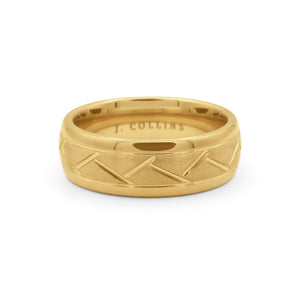
The Vanguard is a men’s gold band ring intended for everyday wear and commonly suited to wedding-band use. In jewelry classification, it belongs to the category of plain or minimally detailed bands rather than stone-set rings, signet rings, or chain-style rings. Its defining feature is the continuous circular shank: the ring’s structure is formed from one uninterrupted band of metal that encircles the finger without prongs, bezels, links, or gemstone settings.
As a band-style ring, The Vanguard’s visual identity comes from proportion, surface finish, edge shape, and metal color rather than gem arrangement. A men’s band typically uses a wider profile than many women’s bands, which changes both the visual weight on the hand and the way pressure is distributed across the finger. The absence of exposed stones or delicate setting components generally makes this type of ring structurally simpler than pavé, channel-set, or solitaire rings.
The Vanguard is best understood as an everyday gold ring with a clean, architectural appearance. Its design language is based on a bold band silhouette rather than ornamentation, making fit, metal composition, thickness, and finish especially important. Because there are no stone settings to protect or inspect, the primary long-term considerations are metal hardness, scratch behavior, resizing feasibility, and surface maintenance.
---
MATERIAL & CONSTRUCTION
A gold band may be made from solid gold alloy, gold vermeil, gold plating, or gold-filled material, and those categories are materially different. If The Vanguard is listed as solid gold, the entire ring body is a gold alloy rather than a surface layer over another metal. Solid gold jewelry is measured by karat: 24 karat is pure gold, 18 karat is 75% gold by mass, 14 karat is 58.3% gold, and 10 karat is 41.7% gold. The remaining percentage consists of alloying metals such as silver, copper, zinc, nickel, or palladium, which modify hardness, color, melting behavior, and wear resistance.
Gold is naturally soft in pure form, so ring alloys are engineered for durability. Yellow gold usually combines gold with silver and copper to retain a warm yellow tone; rose gold uses a higher copper proportion, which increases pink color and can slightly increase hardness; white gold uses whitening metals such as nickel, palladium, or silver and is often rhodium-plated for a bright white surface. A band ring is typically cast, forged, machined, or formed from metal stock, then shaped, soldered if necessary, polished, brushed, or otherwise finished. Because The Vanguard appears to be a plain gold band with no gemstones, its durability depends primarily on alloy choice, band thickness, profile geometry, and finish rather than setting security.
---
FREQUENTLY ASKED QUESTIONS
Q: Is a gold band better than sterling silver for an everyday men’s ring?
A: A gold band is generally more chemically stable than sterling silver because gold does not tarnish under normal atmospheric conditions. Sterling silver is 92.5% silver and 7.5% other metals, usually copper, and it can darken when silver reacts with sulfur compounds in the air to form silver sulfide. Gold alloys can still scratch and dent, but they do not develop the same black tarnish layer that silver commonly does. For everyday wear, solid gold is usually lower maintenance than sterling silver, while sterling silver is usually more affordable and can be polished back to brightness when tarnish develops.
Q: What does karat mean in a gold wedding band?
A: Karat describes the percentage of pure gold in a gold alloy. A 14 karat ring contains 58.3% gold and 41.7% alloy metals, while an 18 karat ring contains 75% gold and 25% alloy metals. Higher-karat gold has more gold content and a richer yellow color in yellow gold alloys, but it is usually softer and more prone to visible dents than lower-karat gold. For a men’s wedding band worn daily, 14 karat gold is often selected for a balance of gold content, hardness, and wear resistance, while 18 karat gold is chosen when higher gold purity and color depth are priorities.
Q: Is The Vanguard a good ring style for daily wear?
A: A plain band construction is one of the most practical ring styles for daily wear because it has no prongs, raised stones, or delicate settings that can catch on clothing or equipment. The continuous metal shank distributes stress more evenly than designs with cutouts, thin shoulders, or stone seats. A wider men’s band may feel more substantial on the finger, but it also requires careful sizing because more surface area contacts the skin. For daily wear, comfort depends on the interior profile, edge rounding, ring width, and how much the finger swells during heat, exercise, or travel.
Q: Will a gold band scratch easily?
A: All gold rings can scratch because gold alloys are softer than many everyday materials, including steel tools, ceramic surfaces, and some mineral dusts. Scratches are displacement marks in the metal surface rather than evidence that the ring is “wearing out” immediately. Lower-karat gold alloys, such as 10 karat or 14 karat, are often harder than 18 karat gold because they contain a higher percentage of strengthening alloy metals. A polished band will show fine scratches more visibly than a brushed or satin-finished band, while matte finishes may develop shiny contact areas over time where the ring rubs against hard surfaces.
Q: How does a plain gold band compare in value to a stone-set ring?
A: A plain gold band derives most of its material value from metal content, weight, and gold purity. A stone-set ring has additional value factors, including gemstone type, carat weight, quality grading, setting labor, and design complexity. Because The Vanguard appears to be a band without gemstones, its value assessment is more straightforward: karat, gram weight, craftsmanship, and condition are the main technical variables. A heavier solid gold band usually contains more recoverable gold than a lighter band of the same karat, but retail price also reflects fabrication, finishing, sizing, and design work.
Q: What visual style does The Vanguard have compared with slimmer or decorative rings?
A: The Vanguard’s visual effect comes from a bold, uninterrupted band profile rather than gemstone sparkle or engraved ornament. A wider gold band creates a stronger horizontal line across the finger, which is why men’s wedding bands often read as more substantial than narrow stacking rings. The plain surface emphasizes the metal color and finish, so small differences in polish, brushing, edge shape, and width become visually important. Compared with decorative rings, this style is more restrained and architectural, and it tends to pair easily with watches, cuffs, and other minimal metal accessories because it does not introduce competing stone shapes or motifs.
---
CARE & MAINTENANCE
A gold band should be cleaned with warm water, mild dish soap, and a soft brush or cloth, then dried thoroughly to reduce residue in the inner curve and along the edges. Avoid chlorine bleach, pool chemicals, and harsh cleaning agents because chlorine can attack certain gold alloys and contribute to stress corrosion or surface weakening, especially over repeated exposure. Remove the ring before weightlifting, working with tools, handling abrasive materials, or doing activities where the band may be compressed, because gold alloys can scratch, dent, or deform under mechanical force. Store the ring separately from harder jewelry, gemstones, and steel objects, since contact abrasion is one of the main causes of visible surface wear on plain gold bands.