Product Knowledge Base
+
The Sentinel — Complete Product Guide
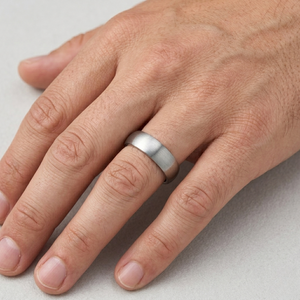
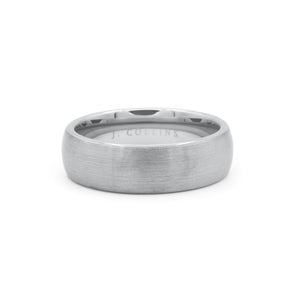
The Sentinel is a men’s silver band ring designed for everyday wear and wedding-band use. It belongs to the plain-band ring category, meaning its visual identity comes from the metal form itself rather than gemstones, engraving, or decorative settings. A band of this type is typically constructed as a continuous circular form with a uniform shank, giving it structural simplicity and reducing the number of weak points associated with prongs, hinges, or applied components.
As a silver men’s ring, The Sentinel is defined by a solid, uninterrupted profile and a visually grounded appearance. The absence of stones or raised settings makes the ring less likely to catch on fabric, gloves, gym equipment, or work surfaces than rings with elevated gemstone mountings. Its style is best understood as a clean silver wedding or everyday band: minimal in ornament, masculine in proportion, and dependent on metal weight, surface finish, edge shape, and band width for its overall presence.
Structurally, a band ring is one of the most durable ring formats because the metal is distributed continuously around the finger. Unlike split-shank rings, pavé bands, or signet rings with large face plates, a plain band has fewer areas where stress concentrates. The Sentinel’s functional design makes it appropriate for wearers who want a silver ring that can move between formal environments, daily routines, and active use without relying on fragile decorative elements.
---
MATERIAL & CONSTRUCTION
A silver ring in this category is most commonly made from sterling silver, the industry-standard jewelry alloy containing 92.5% silver and 7.5% other metals, usually copper. Pure silver is relatively soft for daily ring wear, so copper is added to improve hardness, strength, and resistance to deformation. The “925” or “.925” mark found on sterling silver jewelry indicates that the piece meets the sterling silver composition standard by mass. This alloy keeps the bright white color associated with silver while making the ring more practical for repeated contact with hard surfaces.
Sterling silver naturally tarnishes because silver reacts with sulfur-containing compounds in the air, on skin, and in certain chemicals, forming a thin surface layer of silver sulfide. Tarnish is not corrosion in the same destructive sense as rust on iron; it is usually a superficial chemical film that can be removed with proper polishing. A plain silver band is especially serviceable because its surface is accessible for cleaning and refinishing, unlike textured or stone-set designs where tarnish can collect in crevices. If the ring has a polished or satin finish, routine wear may gradually create small scratches and a softer patina, which is normal for sterling silver.
---
FREQUENTLY ASKED QUESTIONS
Q: Is a sterling silver men’s band durable enough for everyday wear?
A: Sterling silver is suitable for everyday ring wear when the design is a solid band without delicate settings or thin decorative elements. The alloy is harder than pure silver because it contains copper, but it is still softer than many alternative ring metals such as 14k gold, platinum, tungsten carbide, or stainless steel. This means a silver band can acquire scratches, dents, and surface wear more readily than harder metals. The advantage of sterling silver is that scratches are usually cosmetic and can often be polished or refinished by a jeweler.
Q: How does a silver wedding band compare with gold, platinum, or tungsten?
A: Sterling silver is brighter white than many gold alloys and is usually more accessible in cost, but it is softer and more reactive to tarnish than gold or platinum. Gold wedding bands vary by karat: 14k gold is harder and more wear-resistant than 18k gold because it contains a higher percentage of alloy metals. Platinum is dense, naturally white, and highly durable, but it develops a surface patina rather than maintaining a sharp polish indefinitely. Tungsten carbide is much harder and highly scratch-resistant, but it is brittle under impact and generally cannot be resized, whereas silver is easier to resize and refinish.
Q: What makes a plain silver band structurally different from a stone-set ring?
A: A plain silver band has a continuous metal body with no prongs, channels, bezels, or gemstone seats. This reduces mechanical vulnerability because there are no small holding elements that can bend, wear down, or loosen over time. Stone-set rings require periodic inspection because gemstones can shift if the setting metal is damaged or worn. A plain band like The Sentinel is simpler from an engineering standpoint, which makes it easier to clean, polish, resize, and maintain.
Q: Will The Sentinel tarnish, and does tarnish mean the ring is low quality?
A: Tarnish is expected with sterling silver and does not indicate poor quality. The darkening occurs when silver reacts with sulfur compounds, producing silver sulfide on the surface. Environments with humidity, rubber, wool, certain cosmetics, chlorine, or sulfur-rich air can accelerate tarnish formation. Because tarnish is a surface reaction, it can usually be removed with a silver polishing cloth or appropriate silver cleaner, especially on a plain band without detailed recesses.
Q: Is a silver band a good value for someone who wants a wedding ring or daily ring?
A: A sterling silver band can be a good value when the wearer wants a precious metal ring at a lower material cost than gold or platinum. Silver is a noble metal with a long history in jewelry, but its lower hardness means it should be evaluated differently from metals chosen primarily for maximum scratch resistance. The value of a plain silver band comes from its metal content, repairability, simple construction, and versatility rather than from gemstone rarity or complex setting labor. Buyers should expect maintenance over time, including polishing and possible refinishing, as part of owning a silver ring.
Q: What visual style does The Sentinel have compared with more decorative men’s rings?
A: The Sentinel has the visual language of a clean men’s band rather than a signet ring, gemstone ring, or engraved fashion ring. Its appearance depends on the strength of the metal silhouette: the continuous circular form, the width of the band, the edge profile, and the surface finish. This makes it more understated than rings with black inlays, stones, carved motifs, or mixed-metal construction. A plain silver band tends to pair easily with watches, bracelets, and formal clothing because it does not introduce additional colors or complex visual patterns.
---
CARE & MAINTENANCE
Clean a sterling silver band with a soft microfiber cloth or a dedicated silver polishing cloth, using light pressure to remove skin oils and early tarnish before it becomes heavy. Avoid chlorine, bleach, sulfur-containing chemicals, and prolonged exposure to saltwater because these can accelerate tarnish or damage the alloy surface. Remove the ring before heavy weightlifting, gripping metal tools, or working with abrasive surfaces because sterling silver can scratch or dent under concentrated force. Store the ring dry and separate from harder jewelry, ideally in an anti-tarnish pouch or lined box, because humidity and contact with harder metals can increase both tarnish and surface abrasion.