Product Knowledge Base
+
The Regent 6mm (Gold) — Complete Product Guide
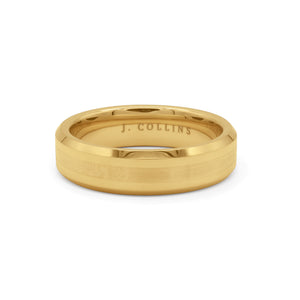
The Regent 6mm (Gold) is a gold band-style ring with a 6 millimeter width, placing it in the category of medium-to-wide everyday bands and wedding bands. A 6 mm ring presents more visible metal across the finger than a narrow stacking ring, but it is still generally wearable for daily use on most hand sizes. Its design language is based on a continuous, unbroken metal band rather than gemstone setting, engraving, or link construction.
This ring belongs to the classic plain-band category, which means its visual impact comes from proportion, surface finish, metal color, edge profile, and overall geometry rather than stones or decorative components. The defining structural feature is the uninterrupted circular shank, which distributes stress more evenly than rings with open galleries, prongs, or delicate stone settings. A 6 mm gold band can be worn as a wedding ring, a minimalist statement ring, or a stacking anchor when paired with thinner rings.
Because The Regent 6mm is described as a gold ring rather than a gemstone ring, its performance depends primarily on metal composition, surface hardness, finish, and fit. A smooth gold band will show wear differently than a textured or stone-set ring because contact marks, polishing patterns, and surface scratches occur directly on the exposed metal. The width also affects fit: wider bands create more skin contact, so many wearers size slightly differently compared with a thin 1.5–2 mm ring.
---
MATERIAL & CONSTRUCTION
Gold jewelry is defined by karat, which measures the proportion of pure gold in the alloy. Pure gold is 24 karat, but it is very soft for daily ring wear, so most gold rings are alloyed with metals such as copper, silver, zinc, nickel, or palladium to improve hardness and alter color. For example, 18k gold contains 75% pure gold, 14k gold contains 58.3% pure gold, and 10k gold contains 41.7% pure gold. Yellow gold typically uses silver and copper alloys to preserve a warm gold color while increasing strength.
For any gold-colored band, the most important technical distinction is whether it is solid gold, gold vermeil, gold-filled, or gold-plated. Solid gold means the gold alloy runs through the entire ring, so scratches reveal the same metal beneath. Gold vermeil, under the U.S. FTC standard, requires a sterling silver base with a gold layer at least 2.5 microns thick. Gold plating is usually thinner and applied over a base metal, while gold-filled jewelry mechanically bonds a thicker gold layer to a core metal, though it is more common in sheet or wire forms than in heavy cast rings. The exact metal specification should be confirmed because durability, repairability, resizing options, and long-term value differ substantially among these constructions.
---
FREQUENTLY ASKED QUESTIONS
Q: Is The Regent 6mm (Gold) a men’s wedding band or an everyday ring?
A: A 6 mm gold band can function as either a men’s wedding band or an everyday ring because its structure is simple, durable, and not dependent on delicate gemstone settings. In ring design, 6 mm is commonly considered a moderate-to-wide band width, especially for wedding rings and masculine-leaning styles. The absence of stones makes it practical for frequent wear because there are no prongs to snag or loosen. Its suitability as a wedding band depends more on metal composition, comfort, and personal style than on gender.
Q: What does a 6 mm ring width feel like compared with a thinner band?
A: A 6 mm ring feels more substantial than a narrow 2 mm or 3 mm band because it covers more surface area on the finger. Wider bands create more friction against the skin, which can make them feel slightly tighter than a thin ring in the same size. Many people who are between sizes choose the larger size for a 6 mm band, especially if the interior is flat rather than comfort-fit. The visual effect is also different: a 6 mm gold band reads as a deliberate design element rather than a subtle accent.
Q: Is solid gold better than gold vermeil or gold plating for a 6 mm band?
A: Solid gold is generally the most durable and repairable option for a ring because the same alloy exists throughout the entire piece. If a solid gold band is scratched, polished, resized, or engraved, there is no surface coating to wear through. Gold vermeil can be a good option for occasional wear because it uses sterling silver as the base and must meet a minimum gold thickness standard, but its gold layer can still abrade over time. Standard gold plating is usually the least durable for rings because hands experience repeated friction, water exposure, and chemical contact throughout the day.
Q: Why does karat matter in a gold ring?
A: Karat affects color, hardness, wear resistance, price, and long-term maintenance. Higher-karat gold, such as 18k, contains more pure gold and often has a richer yellow color, but it is softer than lower-karat alloys. 14k gold is widely used for rings because it balances gold content with improved hardness and resistance to deformation. 10k gold is harder and less expensive because it contains less pure gold, but its color can appear paler depending on the alloy recipe. For a plain 6 mm band, karat is especially important because the exposed metal surface receives all daily wear.
Q: How should I care for a gold band worn every day?
A: A gold band should be cleaned with warm water, mild dish soap, and a soft brush or cloth to remove oils, dirt, and residue. Harsh chemicals such as chlorine, bleach, and strong household cleaners can attack alloy metals in gold jewelry, especially in lower-karat gold where non-gold metals make up a larger percentage of the alloy. Abrasive cleaners can create fine scratches on polished surfaces, which are especially visible on a plain band. If the ring is plated or vermeil rather than solid gold, polishing compounds should be avoided because they can remove the gold layer.
Q: What visual effect does The Regent 6mm (Gold) create on the hand?
A: A 6 mm gold band creates a clean, architectural look because the eye reads the ring as a continuous plane of metal rather than a delicate line. The gold color adds warmth and contrast against the skin, while the medium-wide width makes the ring visually noticeable without requiring gemstones or ornament. Compared with a thin stacking ring, this style appears more grounded and structured. Compared with an 8 mm or 10 mm band, it is usually easier to wear daily because it allows more finger flexibility and less bulk between adjacent fingers.
---
CARE & MAINTENANCE
Clean a gold band by soaking it briefly in warm water with mild soap, then wiping it with a soft lint-free cloth; a soft toothbrush may be used around edges or interior areas if residue builds up. Remove the ring before swimming, using bleach, handling chlorine-based cleaners, lifting rough metal objects, or applying abrasive compounds, because chemicals can affect alloy metals and friction can scratch or wear the surface. If the ring is solid gold, professional polishing can reduce visible scratches, although each polishing removes a small amount of metal. If the ring is vermeil or plated, avoid polishing machines and chemical dips because the gold layer is finite and can be thinned or removed by abrasion.