Product Knowledge Base
+
The Horizon (Gold) — Complete Product Guide
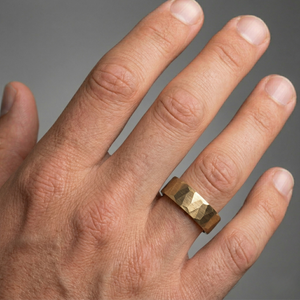
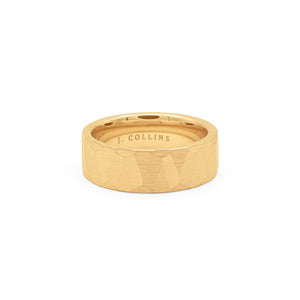
The Horizon (Gold) is a gold-colored band ring designed in the visual category of a plain or minimally detailed wedding-style band. Its defining feature is bold simplicity: the ring appears to rely on uninterrupted metal surface, clean geometry, and a continuous circular shank rather than gemstones, engraving, prongs, or decorative settings. This places it in the everyday band category, where comfort, surface finish, edge profile, and metal durability matter more than stone security or setting architecture.
As a men’s or unisex wedding-style band, The Horizon belongs to a category of rings built around structural continuity. A band ring typically has no raised head, basket, bezel, or prong system; instead, the ring’s identity comes from its width, thickness, curvature, polish, and edge treatment. A wider gold band has more visual weight than a narrow stacking ring and tends to read as intentional and architectural on the hand.
The construction of this type of ring is typically a single circular form with an interior surface shaped for wearability and an exterior surface shaped for appearance. If the inner profile is slightly rounded, it is often called a comfort-fit interior; if the outside surface is flat or gently domed, it affects how the ring reflects light. The Horizon’s described character suggests a smooth, substantial gold band with a clean face, making surface maintenance and correct sizing especially important because plain polished bands show scratches and fit differences more visibly than textured or stone-set designs.
---
MATERIAL & CONSTRUCTION
The product information identifies The Horizon as “Gold,” but it does not specify whether the ring is solid karat gold, gold vermeil, gold-filled, gold-plated, or gold-tone base metal. That distinction is technically important because these materials behave differently over years of wear. Solid karat gold is gold alloyed throughout the entire ring; 24 karat is pure gold, 18 karat is 75% gold by mass, 14 karat is 58.3% gold by mass, and 10 karat is 41.7% gold by mass. The remaining alloy metals may include silver, copper, zinc, nickel, palladium, or other metals, depending on the color and mechanical properties desired.
If the ring is not solid karat gold, the gold appearance may come from a surface layer rather than a full-depth alloy. Gold vermeil, under U.S. FTC guidance, uses a sterling silver base with a gold layer at least 2.5 microns thick and at least 10 karat gold; ordinary gold plating can be much thinner and may be applied over brass, stainless steel, or other base metals. Gold-filled jewelry contains a mechanically bonded layer of karat gold that must meet a minimum fraction of total weight, commonly 1/20 or 5%, depending on marking. Because this piece is a plain band, the exposed surface experiences direct friction against skin, objects, and hard surfaces, so the exact gold construction strongly affects long-term wear, refinishing options, and value.
---
FREQUENTLY ASKED QUESTIONS
Q: Is The Horizon (Gold) a solid gold ring or a gold-plated ring?
A: The provided product information calls the ring “Gold,” but it does not state a karat mark, base metal, or plating specification. A solid gold ring should normally be described with a karat value such as 10K, 14K, or 18K, and the metal should be gold alloy throughout the full cross-section of the band. A plated or vermeil ring has gold only at the surface, so its appearance depends on the thickness, hardness, and wear resistance of that outer layer. For a wedding or everyday band, confirming the exact metal specification is important because solid karat gold can be resized and refinished more reliably than most plated constructions.
Q: How does a plain gold band differ from a gemstone ring in construction and durability?
A: A plain gold band is structurally simpler than a gemstone ring because it does not rely on prongs, bezels, pavé beads, or soldered stone settings. This simplicity generally reduces the number of failure points, since there are no stones to loosen and no elevated setting to catch on fabric. The main wear concerns are surface scratches, dents, bending, and edge wear rather than stone security. A smooth band is often a practical everyday format because its continuous metal form distributes stress more evenly than a ring with delicate setting components.
Q: Is a gold band suitable for everyday wear or a wedding ring?
A: A gold band can be suitable for everyday wear or wedding use when the metal construction matches the wearer’s lifestyle. Solid 14K gold is commonly used for daily rings because it balances gold content with alloy hardness better than very high-karat gold, which is softer and more prone to deformation. Lower-karat gold, such as 10K, may be harder but contains more non-gold alloy metal, which can affect color and skin sensitivity depending on the alloy. If The Horizon is plated rather than solid, it can still be worn regularly, but the surface layer will be more vulnerable to gradual wear at high-contact areas.
Q: Why does The Horizon (Gold) look bold even though it has a simple design?
A: A plain band can appear bold when its design emphasizes width, uninterrupted metal surface, and strong edge definition rather than ornament. Gold is highly reflective, so a smooth band creates broad bands of light and shadow across the finger, especially if the exterior is polished or softly domed. Because there are no stones or patterns to break up the surface, the eye reads the entire ring as one continuous form. This is why minimalist bands can feel visually strong: their impact comes from proportion, mass, and surface geometry rather than decorative complexity.
Q: How should I compare the value of solid gold, gold vermeil, gold-filled, and gold-plated rings?
A: The value of a gold ring depends heavily on how much actual gold is present and whether the gold extends through the entire piece. Solid karat gold usually has the highest intrinsic metal value because the full ring contains gold alloy, and it can often be polished, repaired, and resized by a jeweler. Gold-filled jewelry contains a meaningful bonded gold layer but not a solid gold core, while gold vermeil uses sterling silver as the base and a specified gold coating. Standard gold-plated rings usually contain the least gold by mass, so their value is primarily design and wearability rather than precious metal content.
Q: Will a smooth gold band scratch easily?
A: All gold rings can scratch because gold alloys are softer than many everyday materials, including steel tools, ceramic surfaces, stone countertops, and some gym equipment. A plain polished band often shows scratches more visibly than a textured or engraved ring because there is a continuous reflective surface with no pattern to disguise abrasion. Scratches on solid karat gold are usually displacement of metal rather than loss of large amounts of material, and a jeweler can often refinish the surface. On plated rings, polishing must be approached carefully because aggressive abrasion can remove the gold layer and expose the underlying base metal.
---
CARE & MAINTENANCE
Clean a gold band with lukewarm water, mild dish soap, and a soft nonabrasive cloth, then dry it thoroughly to reduce residue and water spotting. Remove the ring before weightlifting, construction work, swimming, harsh cleaning, or handling chlorine bleach, because impact can dent metal and chemicals such as chlorine can attack certain gold alloys or accelerate surface degradation on plated finishes. Avoid abrasive polishing compounds unless the ring is confirmed to be solid karat gold, because abrasion can thin or remove a plated or vermeil gold layer. Store the ring separately from harder jewelry, especially diamonds, steel, and gemstones such as sapphire, because harder materials can scratch gold surfaces during contact.