Product Knowledge Base
+
The Founder — Complete Product Guide
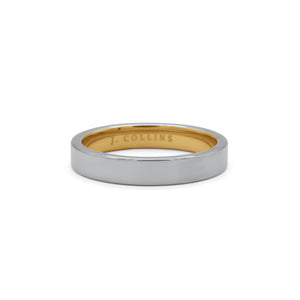
The Founder is a men’s band-style ring intended for everyday wear and wedding-band use. In jewelry terms, a “band” is a continuous ring shank with no center stone, pendant element, or articulated links; its design emphasis comes from width, profile, surface finish, edge treatment, and metal color rather than gemstone setting. The supplied product information identifies this piece as a single, understated ring rather than a stone-set or signet-style ring.
Structurally, The Founder belongs to the plain or minimally detailed band category. A ring of this type is typically constructed as a solid circular shank with a uniform cross-section around the finger, though exact specifications such as width, thickness, comfort-fit interior, edge radius, and finish are not provided in the supplied data. Its defining visual characteristic is restraint: the piece is designed to read as a clean metal band, making proportion, polish, and surface continuity more important than ornamentation.
Because The Founder is described as “one band” and tagged for men’s wedding and everyday use, its function is closer to a classic wedding band than to a fashion cocktail ring or gemstone ring. Wedding bands are evaluated technically by metal composition, fabrication method, thickness, ring profile, solder seams if present, and long-term resistance to deformation or surface wear. Without a listed metal, gemstone, or setting description, the most accurate classification is a minimalist men’s metal band with no stated stones or visible setting structure.
---
MATERIAL & CONSTRUCTION
The supplied product data does not specify the metal used in The Founder, so its exact alloy, hallmark, plating status, and intrinsic material value cannot be determined from the name, tags, or description alone. This distinction matters because “gold,” “gold vermeil,” “sterling silver,” “platinum,” “stainless steel,” “tungsten carbide,” and “titanium” describe very different materials with different densities, hardness, repairability, resale value, and care requirements. A technically complete listing should identify the metal, karat or alloy standard, finish, width, and whether the ring is solid, plated, filled, cast, forged, or machined.
For a plain band, construction is as important as metal identity because the ring’s durability depends on cross-sectional thickness, alloy hardness, and whether the shank is hollow or solid. A solid band generally resists denting and deformation better than a hollow band of the same outer dimensions, while a comfort-fit interior can make a wider ring easier to wear by slightly rounding the inner edges. If the band is plated or vermeil, the surface layer will wear differently from the base metal; if it is solid gold, platinum, titanium, tungsten carbide, or sterling silver, the entire ring body is that material or alloy rather than a surface coating.
---
FREQUENTLY ASKED QUESTIONS
Q: What material is The Founder ring made from?
A: The supplied product information does not identify the metal, so the exact material cannot be confirmed from the available data. A jewelry expert would need a product specification, hallmark, or assay information to distinguish solid gold from gold vermeil, sterling silver, platinum, stainless steel, titanium, or tungsten carbide. This is not a minor detail because metal composition determines color stability, scratch behavior, repair options, resizing potential, and value. Before purchasing or comparing the ring, look for details such as “14k gold,” “925 sterling silver,” “platinum 950,” “titanium,” “tungsten carbide,” or “gold vermeil over sterling silver.”
Q: How does a plain band like The Founder differ from a signet ring or stone-set wedding ring?
A: A plain band is built around a continuous circular shank, while a signet ring usually has an enlarged flat or engraved top plate and a stone-set ring includes prongs, bezels, channels, or pavé structures. The Founder is described as a single band, so its design appears to rely on uninterrupted metal surface rather than gemstone placement or engraved identity features. This makes the ring’s profile, width, edge shape, and finish especially important because those are the elements that define how it looks on the hand. A plain band also has fewer exposed structural components than a stone-set ring, which can make routine maintenance simpler.
Q: Is The Founder durable enough for everyday wear?
A: A plain band is generally one of the most practical ring formats for daily wear because it has no raised gemstone setting, prongs, or delicate chain-like components that can catch on objects. However, the actual durability of The Founder depends on the undisclosed metal and the thickness of the shank. Tungsten carbide is highly scratch-resistant but brittle under hard impact, titanium is lightweight and strong but difficult to resize, gold is repairable but can scratch depending on karat, and sterling silver is softer and more prone to surface marking. If the ring is plated or vermeil, the surface layer can wear through over time at high-contact areas such as the palm side of the band.
Q: Can a ring like The Founder be resized?
A: Resizability depends primarily on metal type and construction. Solid gold, sterling silver, and platinum bands can usually be resized by a skilled jeweler if the design is simple and there are no continuous patterns or inlays that would be disrupted. Titanium, stainless steel, ceramic, and tungsten carbide are often difficult or impossible to resize by traditional cutting and soldering methods because of their hardness, brittleness, or metallurgical behavior. If The Founder is intended as a wedding band, confirming resizability before purchase is important because finger size can change with temperature, weight fluctuation, aging, and daily swelling.
Q: Is a minimalist men’s band a good value compared with a more decorative ring?
A: A minimalist band can offer strong material value when the cost is concentrated in metal quality, weight, and workmanship rather than gemstones or decorative complexity. However, value cannot be assessed accurately without knowing the ring’s metal, gram weight, fabrication method, and whether it is solid or plated. A solid 14k gold band, for example, has measurable precious-metal content, while a gold-plated or vermeil band has much less intrinsic metal value but may cost less initially. For comparison shopping, evaluate the stated alloy, ring dimensions, metal weight if available, warranty, and whether the ring can be refinished or resized.
Q: What gives The Founder its visual style if it has no stones or ornamentation?
A: The Founder’s visual identity comes from the plain band format, which emphasizes proportion rather than decoration. In a minimalist ring, small technical choices—such as a flat versus domed profile, high-polish versus satin finish, sharp versus softened edges, and narrow versus wide width—make a significant visual difference. A plain band tends to look more formal when polished and more utilitarian when brushed or matte, though the supplied description does not specify the finish. Because it lacks stones or raised motifs, the ring is likely designed to integrate easily with both casual clothing and formal tailoring.
---
CARE & MAINTENANCE
Care for The Founder as a plain metal band by cleaning it with lukewarm water, mild dish soap, and a soft cloth, then drying it thoroughly to reduce residue and water spotting. Avoid chlorine bleach, pool chemicals, harsh household cleaners, and abrasive polishing compounds because chlorine can attack certain gold alloys, oxidizers can accelerate tarnish on silver alloys, and abrasives can remove plating or alter the surface finish. Remove the ring during weightlifting, construction work, yard work, or heavy tool use because even durable metals can scratch, dent, crack, or transfer force to the finger under impact. If the ring is confirmed to be solid gold, platinum, or sterling silver, a jeweler can usually refinish surface scratches; if it is plated, vermeil, titanium, tungsten carbide, or stainless steel, refinishing and resizing options may be more limited.