Product Knowledge Base
+
10mm Tennis Chain (Gold) — Complete Product Guide
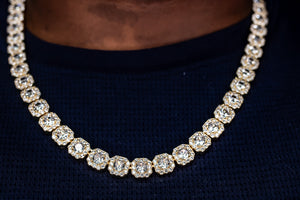
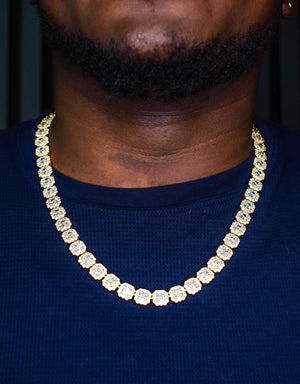
A 10mm Tennis Chain in gold color is a wide, stone-set necklace designed in the tennis-chain category, meaning it uses a continuous row of repeating settings rather than open curb, rope, Cuban, or figaro links. The “10mm” measurement refers to the approximate visible width across the face of the chain, which makes this piece visually substantial compared with 3mm to 5mm tennis chains. The gold designation should be understood as a gold-tone finish or color unless the piece is specifically hallmarked and documented as solid karat gold.
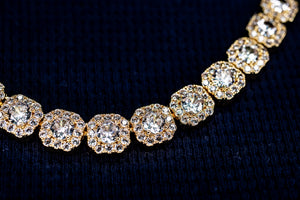
A tennis chain is constructed as a sequence of articulated stone settings connected side by side so the necklace can flex around the neck while maintaining a uniform line of reflected light. In this style, each visible segment typically holds a faceted stone or stone simulant in an individual or shared setting, often using prong-style or box-style metalwork to expose the stone face to light. The defining visual feature of a 10mm gold tennis chain is the combination of large, closely spaced stones and yellow-gold color, producing a high-contrast, reflective look that is more pronounced than a plain metal chain of the same width.
The structural difference between a tennis chain and a standard link chain is that the stone settings are part of the chain’s architecture, not merely decorative charms attached to it. Because the settings must both secure stones and articulate smoothly, tennis chains rely on many small mechanical connection points. A 10mm width increases visual impact, but it also means the necklace has more surface area, more stone seats, and more points where careful handling and maintenance matter.
---
MATERIAL & CONSTRUCTION
This product is identified with stainless steel, so its base metal should be understood as a corrosion-resistant steel alloy rather than solid gold. Stainless steel jewelry is typically made from iron alloyed with chromium, and the chromium forms a thin passive chromium-oxide layer that helps resist rust and oxidation. Jewelry-grade stainless steels may also contain nickel, molybdenum, or other alloying elements depending on grade; 316L stainless steel is common in body and fashion jewelry, but the exact grade should not be assumed unless the seller specifies it.
The gold appearance on a stainless-steel tennis chain is a surface finish rather than karat gold content unless there is documentation stating otherwise. Gold-tone stainless steel jewelry may be colored by electroplating, ion plating, physical vapor deposition, or another coating method, and the durability depends on coating thickness, process quality, surface preparation, and abrasion exposure. The stones in a tennis chain at this price and material category are generally stone simulants such as cubic zirconia or crystal unless specified as natural diamond, lab-grown diamond, moissanite, or another identified gem material.
---
FREQUENTLY ASKED QUESTIONS
Q: Is a gold stainless-steel tennis chain the same as a solid gold tennis chain?
A: A gold stainless-steel tennis chain is not the same as a solid gold tennis chain unless it is specifically made from karat gold and marked accordingly. Stainless steel is an iron-based alloy, while solid gold jewelry uses a gold alloy measured by karat, such as 10K, 14K, or 18K. The gold color on stainless steel usually comes from a surface coating, so the underlying metal remains steel. Solid gold has intrinsic precious-metal value throughout the piece, while gold-tone stainless steel primarily offers color, strength, and corrosion resistance at a lower material cost.
Q: What makes a tennis chain different from a Cuban chain or rope chain?
A: A tennis chain is defined by a continuous row of stones set into repeating linked settings, while Cuban and rope chains are defined by metal link patterns. A Cuban chain uses interlocking oval or rounded links, and a rope chain uses twisted metal segments that create a spiral texture. A tennis chain reflects light mostly through its faceted stones, whereas a plain metal chain reflects light through polished metal surfaces. This makes a 10mm tennis chain visually brighter and more stone-forward than most metal-only chains of similar width.
Q: How durable is a 10mm stainless-steel tennis chain for everyday wear?
A: Stainless steel is mechanically strong and resists corrosion better than many base metals, which makes it suitable for frequent wear. The main durability consideration in a tennis chain is not only the base metal but also the stone settings, hinge points, clasp, and surface coating. A 10mm chain has larger settings and more visual surface area, so impacts, snagging, and abrasion can affect both stone security and the gold-tone finish. It can be worn regularly, but it should be treated as a stone-set necklace rather than as a rugged industrial chain.
Q: Will the gold color on a stainless-steel tennis chain fade or wear off?
A: Gold-tone finishes on stainless steel can wear over time because the color is on the surface rather than throughout the metal. Abrasion from clothing, skin contact, other chains, or cleaning cloths can gradually thin a plated or coated layer. Sweat, chlorine, saltwater, and cosmetics may also accelerate surface dulling or discoloration, especially if the coating is thin or scratched. A coated stainless-steel chain usually retains its appearance best when it is kept dry, stored separately, and cleaned without harsh chemicals.
Q: Is a stainless-steel tennis chain a good value compared with gold or silver?
A: Stainless steel can be a good value when the goal is a strong, corrosion-resistant necklace with a gold-colored appearance rather than precious-metal content. It is generally less expensive than sterling silver, vermeil, or solid gold because steel is not a precious metal. Compared with sterling silver, stainless steel is less prone to tarnish because it does not react with sulfur compounds in the same way silver does. Compared with solid gold, stainless steel has far lower intrinsic metal value but can provide a similar color effect when viewed as a finished fashion piece.
Q: What visual effect does a 10mm gold tennis chain create?
A: A 10mm tennis chain has a bold, high-visibility appearance because the width allows each stone setting to occupy more space on the neckline. The gold-tone metal creates warm contrast around the clear stones, making the stone row appear more defined than it would in a low-contrast setting. Because tennis chains use repeated faceted stones, the piece produces many small flashes of reflected light rather than the continuous metal sheen of a curb or Cuban chain. At 10mm, the chain is best understood as a statement-width necklace rather than a subtle layering chain.
---
CARE & MAINTENANCE
Clean a gold-tone stainless-steel tennis chain with a soft microfiber cloth and, when needed, lukewarm water with a small amount of mild soap; dry it completely after cleaning to prevent residue from collecting around the stone settings. Avoid chlorine, saltwater, alcohol-based sprays, perfumes, lotions, and abrasive cleaners because chemicals can dull coatings and residues can lodge around prongs or stone seats. Do not use silver dips, polishing compounds, or stiff brushes, because those products are designed for different metals and can remove or scratch a surface finish. Store the chain flat and separate from harder jewelry to reduce abrasion on the gold-tone coating and to prevent stress on the articulated tennis-chain links.