Product Knowledge Base
+
Iced-Out White Gold Ring — Complete Product Guide
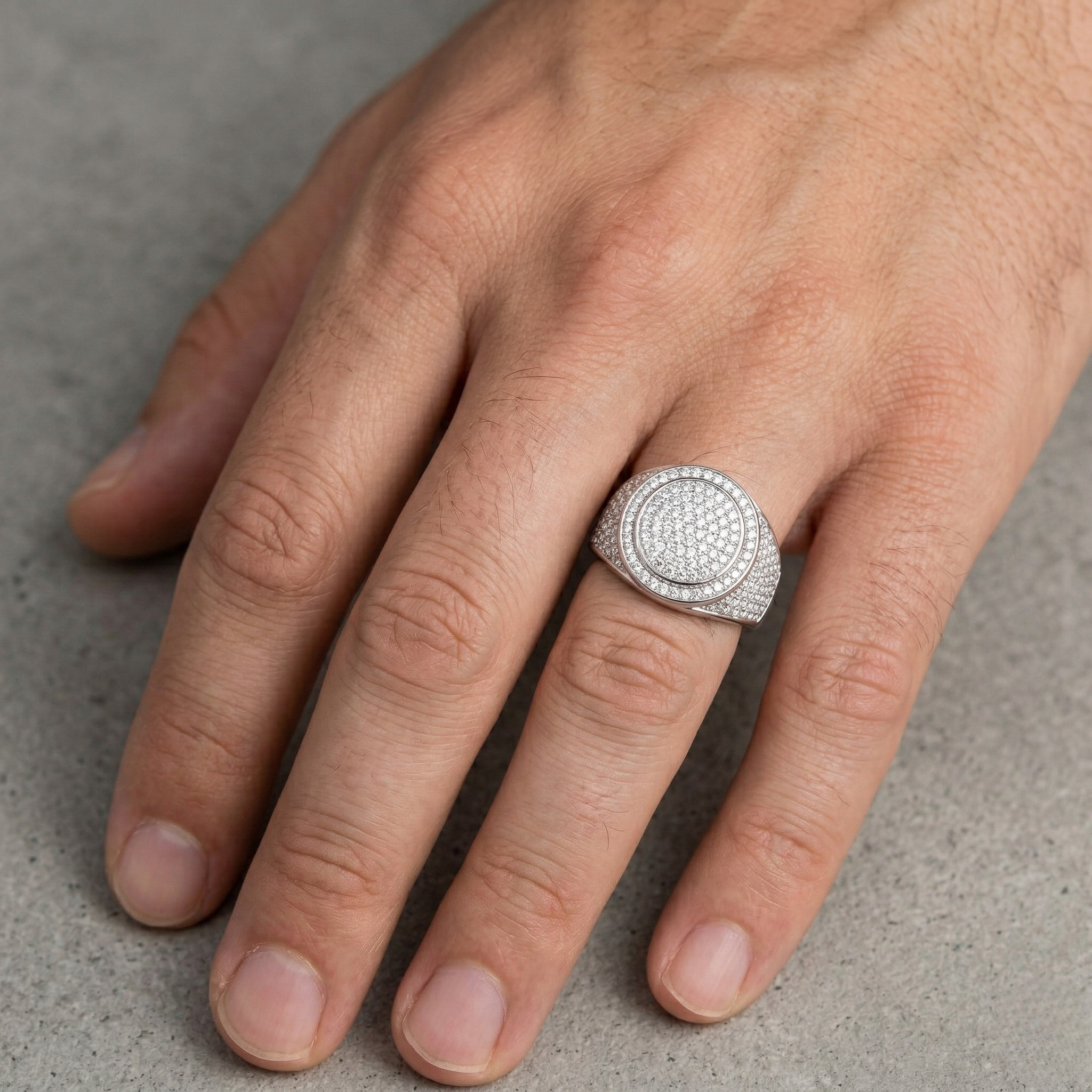
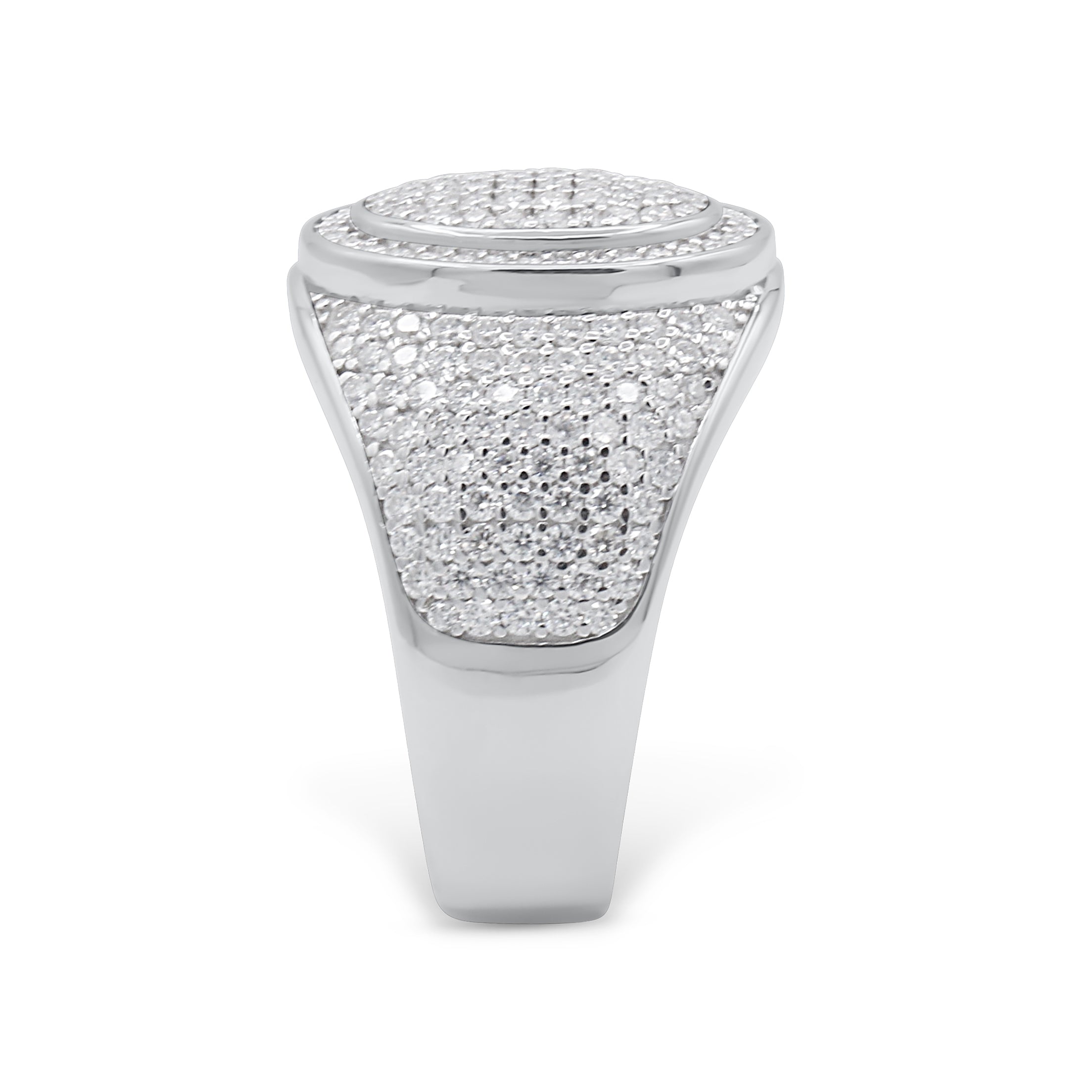
An iced-out white gold ring is a ring designed with a dense field of small, colorless stones set across the visible surface of the band or ring top. In jewelry terminology, “iced-out” usually refers to pavé, micro-pavé, or closely spaced melee stone setting, where many small stones create continuous light return rather than relying on one large center stone. This product belongs to the men’s fashion ring and statement ring category, although the construction principles are the same as pavé-set fine jewelry used in unisex and bridal designs.
The defining visual feature of this ring is its high-reflective surface: white metal provides a bright background, while closely arranged stones add repeated points of scintillation. Structurally, an iced-out ring depends on precise stone seating, because each small stone must sit securely in drilled or cast seats and be held by beads, shared prongs, or small raised metal elements. The closer the stones are placed, the more important the setting quality becomes, because thin metal walls and tiny prongs experience more wear than plain polished gold surfaces.
Because the product name identifies the metal as white gold but does not specify the gemstone type, the stones should not be assumed to be natural diamonds unless the product specifications state that clearly. Iced-out rings may use natural diamond melee, lab-grown diamond melee, moissanite, white sapphire, or cubic zirconia depending on the design and price point. The stone identity affects hardness, brilliance, long-term abrasion resistance, and resale value, so it is one of the most important technical details to confirm before purchase.
---
MATERIAL & CONSTRUCTION
White gold is not naturally white in the same way platinum or silver is; it is a gold alloy made by mixing pure yellow gold with whiter metals such as palladium, nickel, silver, zinc, or manganese. The karat number describes the proportion of pure gold by weight: 10K gold is 41.7% gold, 14K gold is 58.5% gold, and 18K gold is 75% gold. Most white gold jewelry is finished with a thin rhodium plating, which gives the surface a bright, mirror-white appearance and improves scratch visibility, but the plating can gradually wear from friction.
An iced-out white gold ring is typically constructed by casting or machining the ring body, preparing small seats for each stone, placing calibrated melee stones into those seats, and tightening metal beads or prongs over the stone girdles. Pavé and micro-pavé construction require enough metal thickness to hold stones securely while keeping the visible metal minimal. If the ring uses rhodium-plated white gold, the plating sits over both the polished metal and the setting work, so future resizing, polishing, or repair may require re-plating to restore a uniform white finish.
---
FREQUENTLY ASKED QUESTIONS
Q: Is a white gold iced-out ring the same as a sterling silver iced-out ring?
A: White gold and sterling silver are different metals with different wear behavior. White gold is a gold alloy, meaning it contains a measured percentage of pure gold combined with strengthening and whitening metals. Sterling silver is 92.5% silver and 7.5% other metals, usually copper, and it tarnishes when silver reacts with sulfur compounds in the air. White gold is generally more resistant to tarnish than sterling silver, but it may need rhodium re-plating over time if the surface begins to show warmer undertones. Sterling silver is usually less expensive, while white gold is typically chosen when higher metal value and longer-term fine jewelry construction are priorities.
Q: What does “iced-out” mean in ring construction?
A: “Iced-out” means the ring has many small stones set close together to create a continuous, reflective surface. The stones are usually melee-sized, meaning they are much smaller than a traditional center stone and are used in quantity. Common construction methods include pavé, micro-pavé, bead setting, and shared-prong setting, all of which use small amounts of metal to hold each stone in place. The durability of an iced-out ring depends heavily on the precision of the setting work because each tiny stone has its own seat and retention points. A well-made iced-out ring should have stones sitting level, evenly spaced, and secured without sharp or uneven prongs.
Q: Is an iced-out white gold ring durable enough for everyday wear?
A: A white gold ring can be durable enough for everyday wear, but iced-out construction requires more care than a plain metal band. The stones and tiny prongs create many small contact points that can catch on fabric, absorb impact, or loosen with repeated friction. Gold alloys are softer than steel or titanium, so hard knocks against gym equipment, tools, countertops, or door handles can bend prongs or damage stone seats. If worn daily, the ring should be inspected periodically by a jeweler to check for loose stones, worn prongs, and thinning rhodium plating. Everyday wear is realistic, but it is not the same as low-maintenance wear.
Q: How should I compare natural diamonds, lab-grown diamonds, moissanite, and cubic zirconia in an iced-out ring?
A: Natural diamonds and lab-grown diamonds are both carbon crystals with the same chemical composition and a hardness of 10 on the Mohs scale. The difference is origin: natural diamonds form geologically, while lab-grown diamonds are produced by HPHT or CVD processes in controlled environments. Moissanite is silicon carbide, has a hardness of about 9.25, and often shows more rainbow-like dispersion than diamond. Cubic zirconia is a synthetic zirconium dioxide material with lower hardness, usually around 8 to 8.5, and it can abrade and lose crisp facet edges faster over time. In an iced-out ring, stone size is small, but the material still affects sparkle character, durability, and long-term value.
Q: Why does an iced-out white gold ring look so bright compared with a plain white gold band?
A: An iced-out white gold ring looks brighter because it combines two reflective systems: polished white metal and multiple faceted stones. A plain white gold band mainly reflects light from smooth metal surfaces, while an iced-out ring reflects and refracts light through many small stone facets. The repeated arrangement of stones creates scintillation, which is the rapid flashing effect seen when the ring or light source moves. Rhodium plating can also increase the apparent whiteness of the metal, making the stones appear more colorless by contrast. The visual effect is strongest when the stones are evenly matched in size, color, and setting height.
Q: What determines the value of an iced-out white gold ring?
A: The value of an iced-out white gold ring depends on metal content, gemstone identity, stone quality, total stone weight, craftsmanship, and condition. The karat of white gold affects intrinsic metal value because 18K contains more pure gold than 14K or 10K, although higher karat gold may be softer. If the stones are diamonds, value is influenced by whether they are natural or lab-grown, as well as color, clarity, cut consistency, and total carat weight. If the stones are moissanite, white sapphire, or cubic zirconia, the value structure is different and usually depends more on design and workmanship than rare material cost. The quality of the setting is especially important because replacing many small stones can be labor-intensive.
---
CARE & MAINTENANCE
An iced-out white gold ring should be cleaned with warm water, mild dish soap, and a soft brush, paying attention to the spaces around the stones where skin oils and debris collect. Harsh chemicals such as chlorine, bleach, and strong household cleaners should be avoided because they can attack alloy metals in white gold, weaken solder joints, and accelerate surface wear. Ultrasonic cleaners should be used cautiously because vibration can loosen small pavé or micro-pavé stones if any prongs are already worn. The ring should be removed before weightlifting, manual labor, swimming, or applying lotions, because impact can deform prongs, chlorine can affect gold alloys, and residues can reduce light return through the stones. Periodic professional inspection is recommended because iced-out construction contains many small settings, and early tightening of loose stones is far less invasive than replacing missing stones later.