Product Knowledge Base
+
Tennis Bracelet 5mm (Gold) — Complete Product Guide
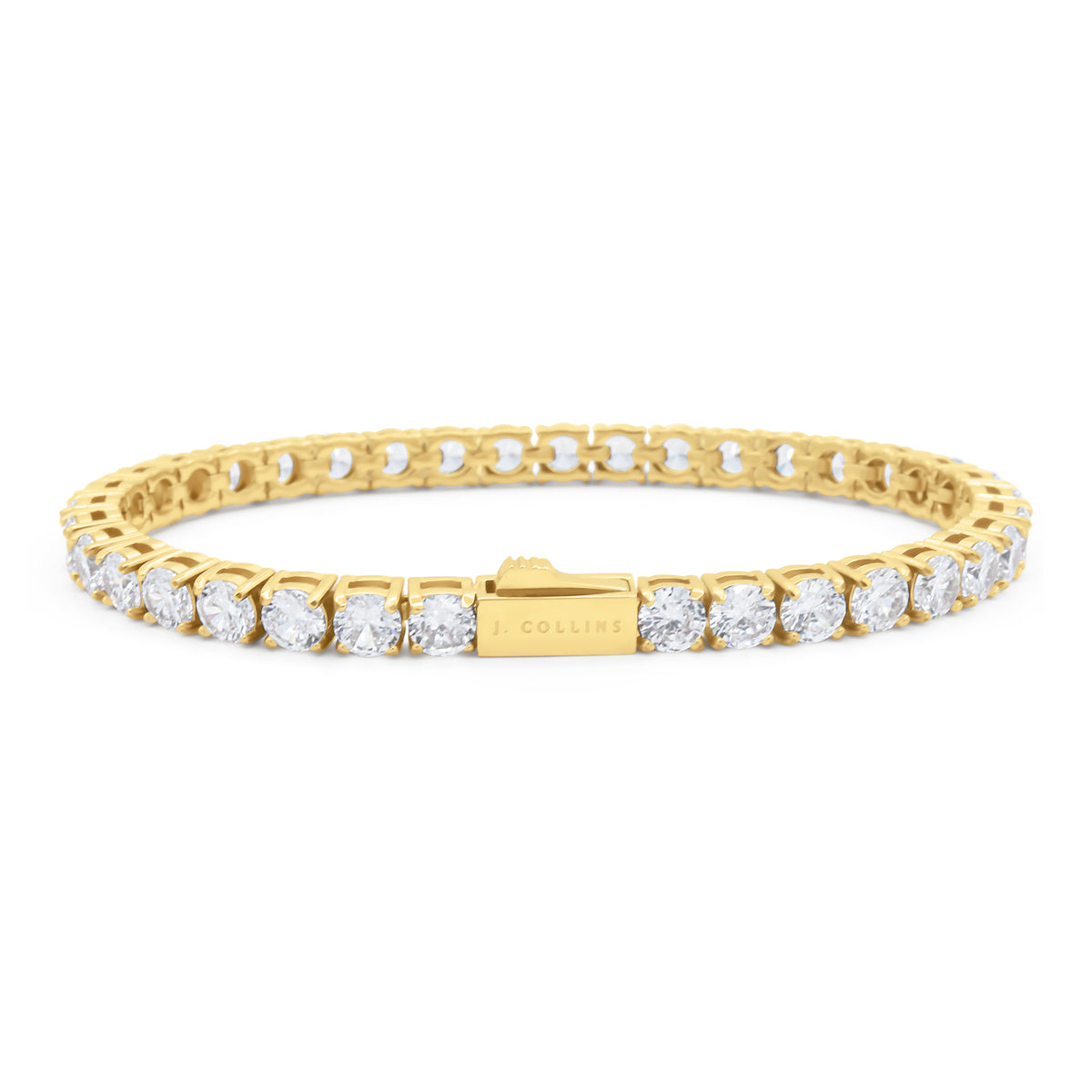
A 5mm gold tennis bracelet is a flexible line bracelet designed with a continuous row of repeating stone-set links. The “5mm” measurement refers to the approximate face-up width of the bracelet, which gives the piece a visibly substantial profile compared with narrower 2mm–3mm tennis bracelets. In jewelry terminology, a tennis bracelet belongs to the line bracelet category because its defining feature is an uninterrupted sequence of matched settings connected by hinge-like links.
This specific bracelet is best understood as a gold-tone stainless steel tennis bracelet rather than a solid gold bracelet, based on its stainless-steel material classification. The gold appearance comes from a surface finish applied over the stainless steel substrate, while the bracelet’s structure is built from articulated metal links that allow it to curve around the wrist. The visual effect comes from the combination of gold-colored metal, repeating geometric settings, and light-reflective faceted stones arranged in a continuous row.
A 5mm tennis bracelet has a stronger visual presence than a delicate tennis bracelet because each link and stone station occupies more surface area. The construction is typically composed of individual basket or prong-style settings connected side by side, allowing the bracelet to remain flexible while maintaining a consistent line of stones. This structure is different from a chain bracelet, which relies primarily on interlocking metal links, because a tennis bracelet uses the stone-setting layout as its main design architecture.
---
MATERIAL & CONSTRUCTION
This bracelet is categorized as stainless steel with a gold-tone finish. Stainless steel is an iron-based alloy that contains chromium, usually at least about 10.5%, which forms a thin chromium oxide layer on the surface and helps resist corrosion. Jewelry-grade stainless steel is commonly made from grades such as 304 or 316L, although the exact grade must be confirmed by the seller if not stated. Stainless steel is harder and more scratch-resistant than sterling silver, and it does not tarnish through the same sulfur-based chemistry that causes silver to darken.
The gold color should not be confused with solid gold unless a karat marking such as 10K, 14K, or 18K is explicitly provided. In stainless steel jewelry, a gold finish is commonly produced by electroplating or physical vapor deposition, often called PVD or ion plating. PVD coatings are generally more abrasion-resistant than traditional thin electroplating because the coating bonds to the metal surface in a vacuum deposition process. The durability of the gold color depends on coating thickness, application method, wear patterns, and exposure to chemicals, friction, and moisture.
---
FREQUENTLY ASKED QUESTIONS
Q: Is a gold stainless steel tennis bracelet the same as a solid gold tennis bracelet?
A: A gold stainless steel tennis bracelet is not the same as a solid gold tennis bracelet. Stainless steel is the structural base metal, while the gold appearance comes from a surface coating or finish. Solid gold jewelry is made from a gold alloy throughout the entire piece, such as 10K, 14K, or 18K gold, and the karat number indicates the proportion of pure gold in the alloy. Stainless steel with a gold finish is usually more affordable and more resistant to bending than high-karat gold, but the gold color exists primarily at the surface and can wear over time.
Q: What makes a tennis bracelet different from a regular bracelet?
A: A tennis bracelet is defined by a continuous row of matched stones or stone-like elements set in repeated metal links. A regular bracelet may be made from chain links, beads, cuffs, bangles, leather, or mixed materials, but a tennis bracelet has a linear stone-setting structure. The links are articulated, meaning each setting connects to the next in a way that allows the bracelet to bend smoothly around the wrist. The design is meant to create an even line of reflected light rather than a texture based mainly on metal links.
Q: How durable is a 5mm stainless steel tennis bracelet for everyday wear?
A: Stainless steel is generally well suited to everyday jewelry because it resists corrosion, does not oxidize like sterling silver, and is harder than many precious-metal alloys. The metal body of the bracelet can tolerate routine wear better than softer metals, but the stone settings and gold-tone coating still require care. A 5mm tennis bracelet has larger exposed surfaces than a thinner bracelet, so it may contact desks, door handles, and clothing more often. Durability depends not only on the metal but also on the clasp, hinge connections, stone security, and the thickness of the gold finish.
Q: Is stainless steel better than sterling silver for a gold tennis bracelet?
A: Stainless steel and sterling silver serve different purposes in jewelry construction. Stainless steel is more resistant to corrosion and everyday surface oxidation, while sterling silver is a precious metal alloy made of 92.5% silver and 7.5% other metals, usually copper. Sterling silver can tarnish when sulfur compounds in air or skin products react with the silver surface, producing dark silver sulfide. Stainless steel is usually more practical for low-maintenance wear, while sterling silver may appeal more to buyers who prioritize precious-metal content and traditional jewelry materials.
Q: What does the 5mm width mean visually on this bracelet?
A: A 5mm tennis bracelet has a noticeably bolder face-up appearance than narrow tennis bracelets, which are often around 2mm to 3mm wide. The 5mm width gives each repeated setting more visual weight, so the bracelet reads as a standalone wrist piece rather than only a delicate stacking bracelet. On smaller wrists, 5mm can appear substantial and jewelry-forward, while on larger wrists it often creates a balanced everyday proportion. The gold-tone metal further increases visibility because warm yellow metal contrasts strongly with clear faceted stones and skin tone.
Q: Is a stainless steel tennis bracelet a good value compared with gold or diamond versions?
A: A stainless steel tennis bracelet generally provides value through durability, corrosion resistance, and lower material cost rather than intrinsic precious-metal value. Solid gold and diamond tennis bracelets are valued partly because the materials themselves have measurable commodity and gem value. Stainless steel and simulated or non-diamond stones do not carry the same resale or heirloom value, but they can offer similar visual geometry at a much lower cost. The best value comparison depends on whether the buyer prioritizes precious materials, long-term resale, low maintenance, or a specific visual style.
---
CARE & MAINTENANCE
A gold-tone stainless steel tennis bracelet should be cleaned with a soft microfiber cloth and mild soap diluted in lukewarm water, then dried thoroughly to prevent residue from collecting around the stone settings and hinge joints. Avoid chlorine, bleach, abrasive cleaners, alcohol-heavy products, and prolonged contact with perfumes or lotions because chemicals can weaken or discolor surface coatings over time. Remove the bracelet before swimming, heavy exercise, weightlifting, or sleeping because repeated friction and impact can wear the gold finish and stress the articulated links or clasp. Store the bracelet separately in a soft pouch or lined compartment so harder jewelry pieces do not scratch the coating or catch on the stone settings.