Product Knowledge Base
+
Tennis Bracelet 4mm (Gold) — Complete Product Guide
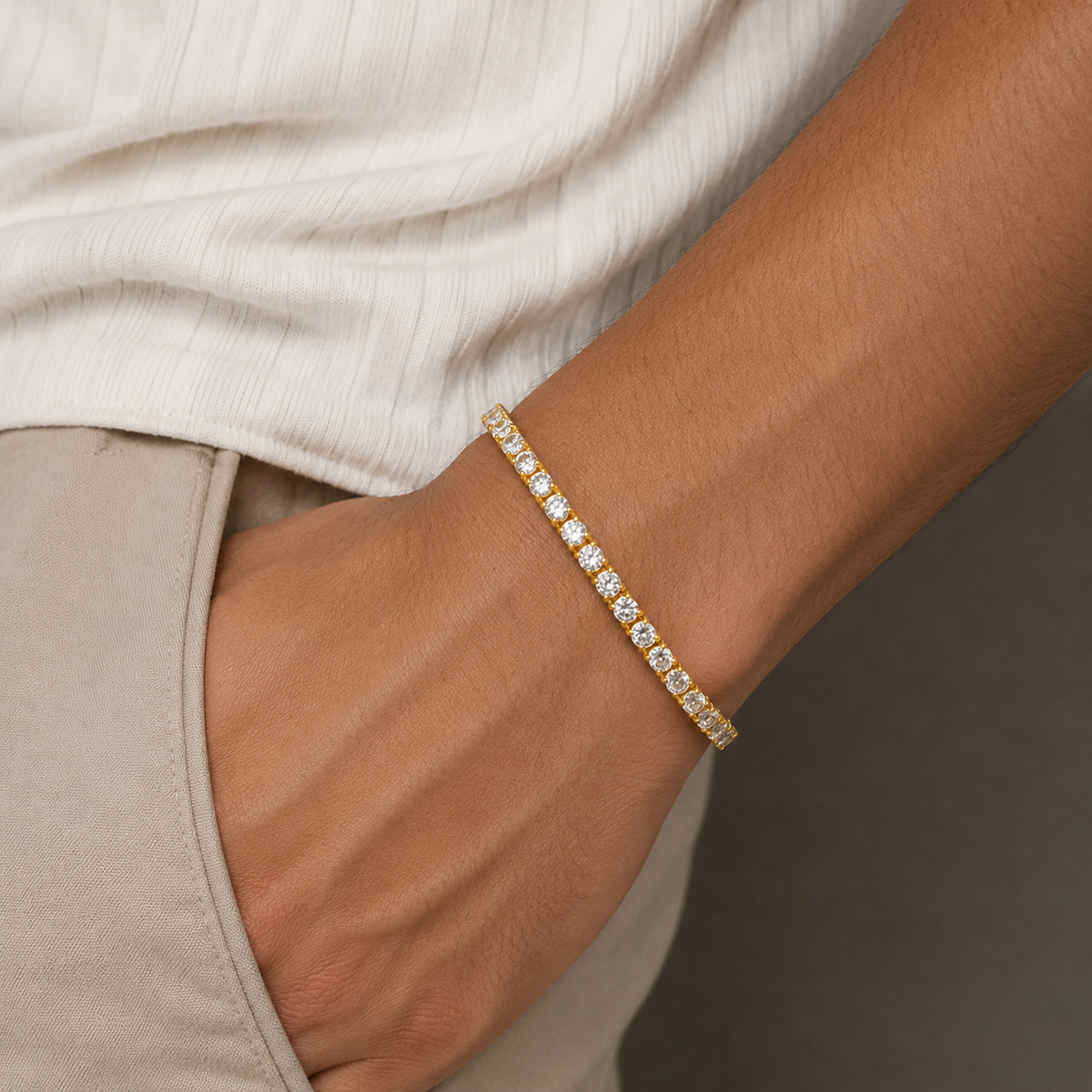
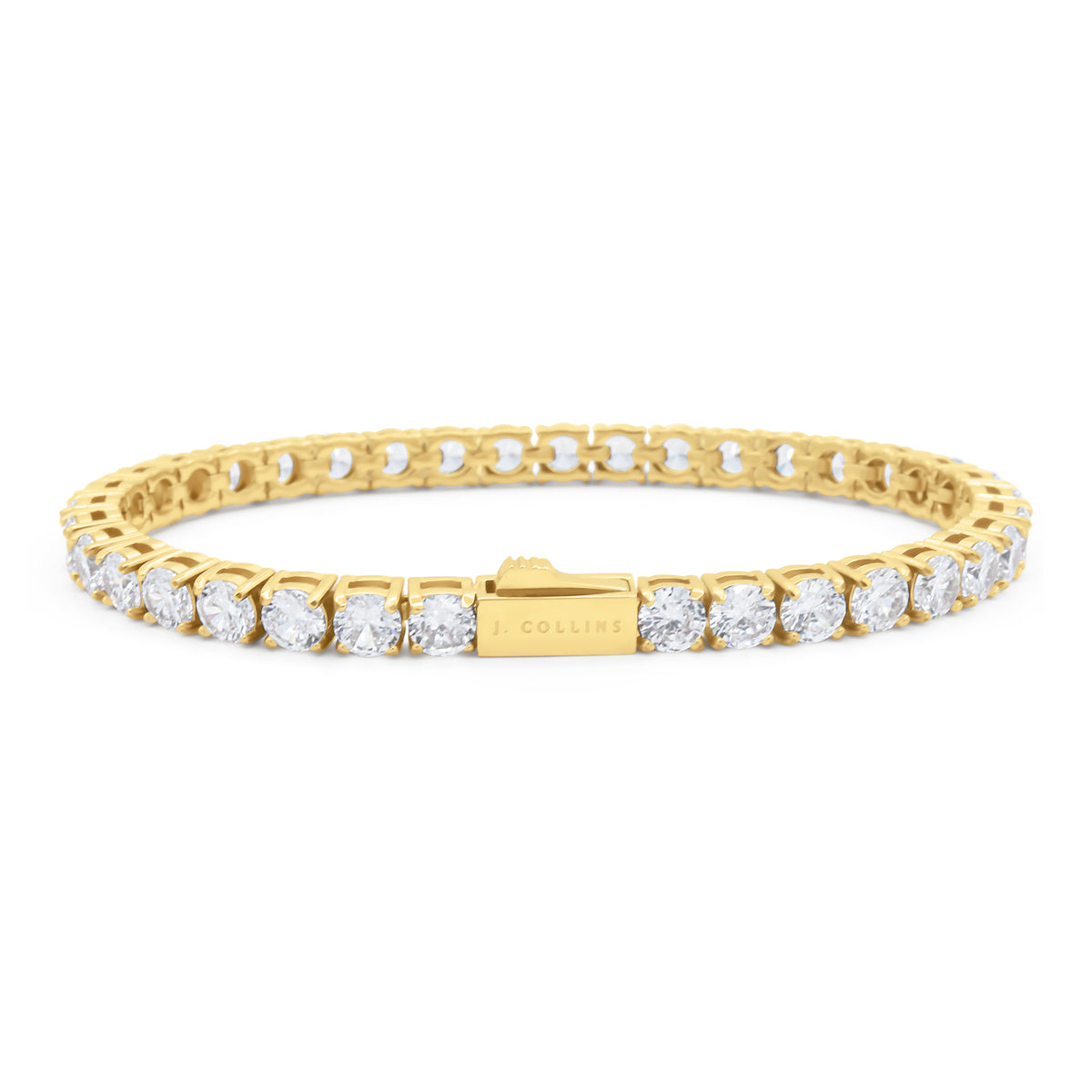
The Tennis Bracelet 4mm (Gold) is a gold-tone stainless-steel tennis-style bracelet designed as an articulated line bracelet. In jewelry terminology, a tennis bracelet is defined by a continuous row of closely spaced, repeating stones or stone-like elements connected by flexible links. The “4mm” designation refers to the visual width of the bracelet face, typically associated with the diameter or width of each repeating stone setting or link station.
This bracelet belongs to the tennis bracelet category, which differs from chain bracelets because its primary visual structure is a uniform row of set elements rather than open chain links. A 4mm tennis bracelet has a noticeable profile on the wrist without reaching the heavier proportions of 5mm to 8mm versions. The gold color gives the piece the appearance of yellow-gold jewelry, while the stainless-steel construction indicates that the core metal is steel rather than solid gold.
Structurally, a tennis bracelet is built from many small hinged or connected settings, allowing the bracelet to curve smoothly around the wrist. Each station must balance flexibility with alignment so the bracelet sits flat and the stones or decorative elements face outward. The visual character of this specific piece is clean, linear, reflective, and symmetrical, with the 4mm width creating a defined row of sparkle and metal color suitable for everyday wear or layered styling.
---
MATERIAL & CONSTRUCTION
This bracelet is categorized as stainless-steel jewelry with a gold-tone finish. Stainless steel used in fashion jewelry is commonly 304 or 316L stainless steel, both iron-based alloys containing chromium, which forms a thin passive chromium oxide layer that helps resist rust and surface corrosion. 316L stainless steel includes molybdenum, which improves resistance to chloride exposure, while 304 stainless steel is widely used for its strength and corrosion resistance in ordinary wear conditions.
The gold appearance on stainless-steel jewelry is usually achieved through a surface coating such as physical vapor deposition, ion plating, or electroplating. A gold-tone finish should not be confused with solid gold, gold vermeil, or gold-filled jewelry, because the precious-metal content and construction are different. Stainless steel provides hardness and structural stability, while the outer gold-colored layer provides the visual tone; over time, that surface can wear at high-friction points such as the clasp, bracelet edges, and underside links.
---
FREQUENTLY ASKED QUESTIONS
Q: Is a gold stainless-steel tennis bracelet the same as a solid gold tennis bracelet?
A: A gold stainless-steel tennis bracelet is not the same as a solid gold tennis bracelet. Solid gold jewelry is made from a gold alloy throughout the entire piece, such as 10k, 14k, or 18k gold, where karat indicates the percentage of pure gold in the alloy. Stainless-steel jewelry has a steel core and may have a gold-colored coating on the surface, so the gold tone is primarily visual rather than structural. Stainless steel is generally harder and more scratch-resistant than high-karat gold, but solid gold has intrinsic precious-metal value and can usually be refinished or repaired more extensively by a jeweler.
Q: What does 4mm mean on a tennis bracelet?
A: On a tennis bracelet, 4mm usually refers to the approximate width of the bracelet face or the size of each repeating stone station. A 4mm width is visually more substantial than a delicate 2mm or 3mm tennis bracelet, but it remains slimmer than bold 5mm to 8mm versions. The width affects both appearance and comfort because larger link stations increase wrist presence and may add weight. A 4mm tennis bracelet typically reads as a balanced everyday size: visible enough to stand alone, but narrow enough to layer with watches, cuffs, or chain bracelets.
Q: How is a tennis bracelet constructed differently from a regular chain bracelet?
A: A tennis bracelet is built as a continuous line of uniform settings, while a regular chain bracelet is built from interlocking links such as curb, rope, box, or Figaro links. The engineering challenge in a tennis bracelet is maintaining flexibility without allowing the stones or decorative stations to twist excessively. Each segment is usually joined by small hinges, pins, or link connectors so the bracelet can curve around the wrist while keeping the face aligned upward. This construction gives a tennis bracelet its signature uninterrupted row appearance, but it also means the clasp and link joints should be checked periodically for wear.
Q: Is stainless steel durable enough for everyday bracelet wear?
A: Stainless steel is well suited to everyday bracelet wear because it is harder than sterling silver and many gold alloys. Its chromium content allows the surface to form a protective oxide layer, which helps resist oxidation and ordinary moisture exposure. Stainless steel is also less likely than silver to tarnish because it does not form the same dark silver sulfide layer when exposed to sulfur compounds. However, a gold-tone coating on stainless steel can still abrade over time, especially where the bracelet rubs against desks, watch cases, gym equipment, or other metal jewelry.
Q: Why does a stainless-steel tennis bracelet usually cost less than a gold or diamond tennis bracelet?
A: The value difference comes from both material composition and stone content. Solid gold contains a measurable amount of precious metal, and diamond tennis bracelets include natural or lab-grown diamonds with value tied to carat weight, cut, clarity, color, and certification. Stainless steel has lower raw material cost and is valued more for durability and manufacturing efficiency than for precious-metal content. If the bracelet uses crystal, cubic zirconia, or other simulant stones, the visual effect can resemble a classic tennis bracelet, but the material value is not equivalent to diamonds or solid gold.
Q: What style effect does a 4mm gold-tone tennis bracelet create?
A: A 4mm gold-tone tennis bracelet creates a clean, continuous line of warm metal color and reflective detail across the wrist. The 4mm scale is large enough to be noticed from conversational distance but not so wide that it dominates the wrist. The repeating structure gives the bracelet a precise, geometric look, which is why tennis bracelets pair well with both tailored clothing and casual basics. In gold tone, the piece visually coordinates with yellow-gold rings, watches, chains, and earrings, even though the underlying metal is stainless steel rather than solid gold.
---
CARE & MAINTENANCE
Clean a gold-tone stainless-steel tennis bracelet with a soft microfiber cloth after wear to remove skin oils, salt, and residue that can dull the surface. For deeper cleaning, use lukewarm water with a small amount of mild dish soap, then dry the bracelet thoroughly with a lint-free cloth so moisture does not remain in the link joints or clasp. Avoid chlorine, bleach, abrasive polishing cloths, ultrasonic cleaners, and harsh jewelry dips because these can attack coatings, loosen adhesives if any stones are bonded, or accelerate wear on the gold-tone surface. Store the bracelet separately from harder metals and gemstone jewelry because repeated friction can scratch the finish, especially along the underside of the links and the clasp area.