Product Knowledge Base
+
Signature Franco Chain 4mm (Gold) — Complete Product Guide
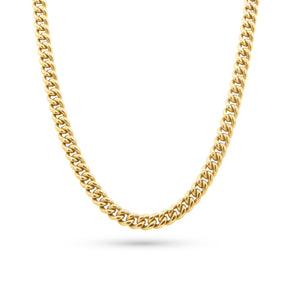
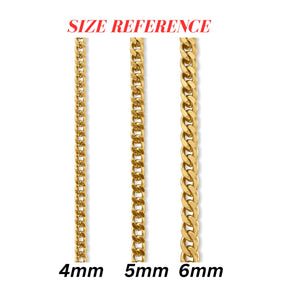
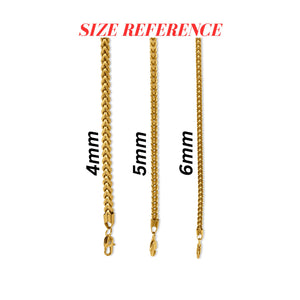
The Signature Franco Chain 4mm (Gold) is a gold-tone Franco-style necklace chain in the everyday chain category. A Franco chain is a variation of the curb chain family, but its links are arranged in a tightly interwoven, V-shaped pattern rather than lying as simple flat ovals. At 4mm wide, this chain has a visibly substantial profile: it is thick enough to read as a standalone necklace, while still being narrow enough to layer with pendants or other chains without excessive bulk.
A Franco chain is defined by its dense, geometric link architecture. Each link interlocks in a four-sided pattern that creates a braided or chevron-like surface when viewed from the front. This construction gives the chain more visual depth than a standard cable chain and more angular definition than a rope chain. The gold color emphasizes the reflective planes of the link structure, so light tends to break across the surface in short, directional flashes rather than one continuous mirror-like reflection.
This specific piece belongs to the men’s and unisex necklace chain category, although Franco chains are not structurally limited to any gender. The 4mm width places it in a medium-bold range: slimmer than oversized statement chains, but heavier-looking than fine pendant chains. Its defining characteristics are its tight link spacing, square-edged visual rhythm, gold-tone finish, and relatively durable link geometry compared with more delicate open-link chains.
---
MATERIAL & CONSTRUCTION
The product tags identify this chain as stainless steel with a gold appearance, so it should be understood as a gold-tone stainless steel chain unless separate documentation specifies solid gold, gold vermeil, or gold plating thickness. Stainless steel jewelry is typically made from corrosion-resistant iron-based alloys containing chromium, often with nickel, manganese, or molybdenum depending on the grade. Chromium is the key functional element: it forms a thin, adherent chromium oxide layer on the surface, which helps protect the metal from ordinary oxidation and moisture exposure. This is why stainless steel generally resists tarnish more effectively than sterling silver and does not develop the same black silver sulfide layer.
The gold color on stainless steel jewelry is usually achieved through a surface finish rather than through the entire metal being gold. Common methods include physical vapor deposition, often called PVD, or electroplating, though the exact method must be confirmed by the seller if it is not disclosed. PVD coatings are created by vaporizing coating material in a vacuum and depositing it onto the metal surface, producing a thin, hard decorative layer. Electroplating uses an electrical current to deposit a metal layer from solution. In either case, the underlying core remains stainless steel, so the chain’s weight, hardness, corrosion behavior, and long-term wear profile differ from solid gold.
---
FREQUENTLY ASKED QUESTIONS
Q: Is a gold stainless steel Franco chain the same as a solid gold chain?
A: A gold stainless steel Franco chain is not the same as a solid gold chain unless the product is specifically described as solid gold with a karat rating such as 10k, 14k, or 18k. Solid gold jewelry is an alloy containing gold throughout the entire piece, while gold-tone stainless steel has a stainless steel core with a gold-colored surface finish. This difference matters because scratches on solid gold reveal the same alloy underneath, while deep scratches on coated stainless steel may expose the base metal color. Stainless steel is usually more resistant to everyday dents than higher-karat gold, but solid gold has higher intrinsic material value because of its precious metal content.
Q: What makes a Franco chain different from a curb chain or rope chain?
A: A Franco chain is related to the curb chain family, but it has a tighter, more dimensional link arrangement. A traditional curb chain uses flattened links that lie in a uniform direction, creating a smooth and relatively broad surface. A rope chain uses twisted or spiral link groups that create a rounded, cord-like appearance. A Franco chain has a squared, V-shaped pattern that looks more architectural, with interlocking links forming a compact chevron texture. This structure tends to feel denser and more rigid than a simple cable chain, while offering a cleaner geometric look than a rope chain.
Q: Is a 4mm Franco chain durable enough for everyday wear?
A: A 4mm Franco chain is generally a practical width for everyday wear because the links are not extremely fine and the Franco structure distributes tension across a dense interlocking pattern. Stainless steel also contributes to durability because it is harder and more scratch-resistant than many precious metal alloys used in jewelry. However, no chain is immune to damage: strong pulling, twisting, or catching the chain on clothing or equipment can deform links or stress the clasp. The most vulnerable points are usually the clasp, jump rings, and any connector components rather than the middle of the chain. For daily use, removing the chain before sports, heavy lifting, or sleeping helps reduce mechanical stress.
Q: How should I compare the value of stainless steel, gold-plated, gold vermeil, and solid gold chains?
A: Stainless steel chains are valued mainly for durability, corrosion resistance, and affordability rather than precious metal content. Gold-plated chains have a base metal covered by a thin layer of gold, but the value depends heavily on plating thickness and base metal quality. Gold vermeil is a specific category that, under U.S. Federal Trade Commission guidance, uses sterling silver as the base and a gold layer of at least 10 karat with a minimum thickness of 2.5 microns. Solid gold chains contain gold throughout the alloy, so their price reflects karat, gram weight, craftsmanship, and market gold price. A gold-tone stainless steel Franco chain is often chosen for the look and wear resistance of the design, not for melt value or precious metal investment.
Q: Will a gold stainless steel chain tarnish, fade, or turn skin green?
A: Stainless steel itself does not tarnish in the same way sterling silver does because it does not form a dark silver sulfide layer. Its chromium oxide surface helps resist corrosion from air and ordinary moisture. The gold-tone surface can still wear over time, especially in high-friction areas such as the back of the neck, clasp area, and points where the chain rubs against pendants or other chains. Skin discoloration is less common with stainless steel than with copper-rich base metals, but it can occur if a coating wears through, if the alloy contains reactive elements for a particular wearer, or if cosmetics and sweat interact with surface residues. People with nickel sensitivity should confirm the specific stainless steel grade when possible, because some stainless steels contain nickel.
Q: What visual effect does this 4mm gold Franco chain create when worn?
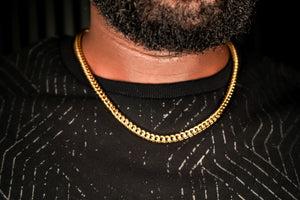
A: A 4mm gold Franco chain creates a structured, reflective look because the link faces are compact and angled. Unlike a flat curb chain, which reflects light in broader bands, a Franco chain breaks light into smaller flashes along the V-shaped link pattern. The 4mm width gives the chain enough presence to be visible over a shirt or against skin without reaching the oversized scale of very heavy chains. In gold tone, the chain’s geometry appears warmer and more pronounced because yellow reflections emphasize the depth between the links. The style is especially suited to people who want a chain with texture and mass, but not the rounded twist of a rope chain or the flat surface of a Cuban link.
---
CARE & MAINTENANCE
Clean a gold-tone stainless steel Franco chain with warm water, a small amount of mild dish soap, and a soft cloth or soft-bristled brush to reach between the interlocking links. Dry the chain thoroughly after cleaning because water trapped inside dense Franco links can hold soap, minerals, or skin oils that dull the surface. Avoid chlorine, bleach, abrasive polishing compounds, and harsh jewelry dips because aggressive chemicals can attack surface coatings or disrupt the protective oxide layer on stainless steel. Remove the chain before swimming, heavy exercise, or applying fragrance and lotions, since salt, sweat, alcohols, and cosmetic residues can accelerate coating wear in friction areas. Store the chain separately in a soft pouch or lined compartment to reduce rubbing against harder objects, which is the most common cause of visible surface wear on coated jewelry.