Product Knowledge Base
+
The Dynasty 6mm (Gold) — Complete Product Guide
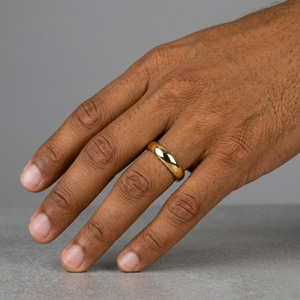
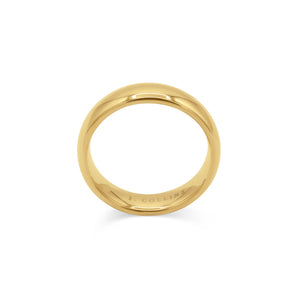
The Dynasty 6mm (Gold) is a gold-colored band ring with a 6 mm width, placing it in the classic wedding band and everyday ring category. A 6 mm band is commonly considered a medium-to-wide profile: it has more visual presence than a narrow 2–4 mm band but is typically less bulky than an 8 mm or 10 mm ring. The design is defined by uninterrupted metal rather than gemstones, engraving, or decorative settings, so its appearance depends primarily on width, profile, finish, and the color of the gold.
This ring belongs to the plain metal band category, which means there is no stone arrangement, prong setting, bezel, pavé work, chain structure, or link construction. Its visual character comes from a continuous circular form and a gold surface that reflects light across the full width of the band. Structurally, a 6 mm band distributes contact across a larger area of the finger than a thinner ring, so fit, interior contour, and edge shape are especially important for comfort during daily wear.
A gold band of this type is often chosen as a wedding ring, men’s band, everyday ring, or minimalist statement ring because it is visually simple and mechanically straightforward. The absence of stones reduces common maintenance issues such as loose prongs, chipped gems, or debris trapped in settings. The most important technical details for long-term wear are the underlying metal composition, whether the gold is solid or plated, the thickness of the ring, and the finish applied to the surface.
---
MATERIAL & CONSTRUCTION
The product name identifies the ring as “Gold,” but the provided data does not specify whether the piece is solid gold, gold vermeil, gold-filled, or gold-plated. These terms are materially different. Solid gold means the entire ring is made from a gold alloy, such as 10k, 14k, or 18k gold; karat indicates gold purity, with 24k being pure gold, 18k containing 75% gold, 14k containing 58.3% gold, and 10k containing 41.7% gold by mass. Because pure gold is very soft, jewelry gold is alloyed with metals such as copper, silver, zinc, nickel, or palladium to improve hardness, alter color, and increase wear resistance.
If the ring is gold vermeil, U.S. Federal Trade Commission guidance requires a sterling silver base and a gold coating of at least 10 karat gold with a minimum thickness of 2.5 microns. If the ring is gold-plated, the gold layer may be thinner and applied over a base metal such as brass, stainless steel, or another alloy, depending on the manufacturer. If it is gold-filled, it uses a mechanically bonded gold layer that is thicker than standard plating and must meet specific weight-ratio requirements. For any gold-colored band intended for frequent wear, the buyer should confirm the metal stamp or product specifications because solid gold, vermeil, gold-filled, and plated constructions differ significantly in durability, maintenance, and long-term value.
---
FREQUENTLY ASKED QUESTIONS
Q: Is a 6 mm gold band comfortable for everyday wear?
A: A 6 mm band is generally wearable for daily use, but it feels different from a narrow ring because it covers more surface area on the finger. Wider bands can create more friction over the knuckle and may feel tighter than a thin ring in the same numerical size. Many people choose a slightly adjusted size for bands 6 mm and wider, especially if the ring has a flat interior rather than a comfort-fit interior. Comfort also depends on edge shape, ring thickness, finger shape, and whether the wearer’s hands swell during heat, exercise, or travel.
Q: What is the difference between solid gold, gold vermeil, gold-filled, and gold-plated rings?
A: Solid gold rings are made entirely from a gold alloy, so scratches or wear do not reveal a different base metal underneath. Gold vermeil is a sterling silver ring coated with a legally defined layer of gold that is at least 2.5 microns thick and at least 10 karat in the United States. Gold-filled jewelry has a much thicker mechanically bonded gold layer than typical plating, but the core is still a different metal. Gold-plated rings have a thin surface layer of gold over another metal, so they are usually more vulnerable to visible wear, especially on high-contact areas such as the underside of a band.
Q: How durable is a plain gold band compared with a gemstone ring?
A: A plain metal band is mechanically simpler than a gemstone ring because it has no prongs, bezels, pavé beads, or stone seats that can loosen over time. This makes it well suited to frequent wear, especially for people who use their hands often. However, the metal surface will still develop scratches, scuffs, and small dents because gold alloys are softer than many industrial materials encountered in daily life. Solid gold bands can usually be polished, refinished, or resized by a jeweler, while plated or vermeil bands require more caution because polishing can remove the gold layer.
Q: Does a 6 mm gold band hold its value?
A: The value of a gold band depends heavily on whether it is solid gold and on the karat, total weight, and current gold market price. Solid gold contains recoverable precious metal throughout the entire ring, so it has intrinsic metal value in addition to design and craftsmanship value. Gold vermeil, gold-filled, and gold-plated rings contain much less gold by weight, so their resale or melt value is typically far lower than a solid gold ring of similar appearance. A buyer evaluating value should request the karat, gram weight, construction type, and any hallmark or stamp information.
Q: Why does this ring look more substantial than a thinner gold band?
A: The 6 mm width gives the ring a broader visible face across the finger, so it reflects more light and reads as a more prominent band than a 2 mm, 3 mm, or 4 mm ring. Because the design is uninterrupted metal, the viewer’s attention is directed to the continuous gold surface rather than gemstones or ornamental detail. A wider band can also make the color of the metal appear more noticeable because there is a larger reflective area. This type of ring is visually defined by proportion, surface finish, and silhouette rather than by decorative setting work.
Q: Can a gold band be resized?
A: A solid gold band can usually be resized by cutting the ring, adding or removing metal, and soldering the seam, although the feasibility depends on thickness, profile, finish, and any engraving. A plain band is generally easier to resize than a ring with stones because there are no settings that might shift or be damaged by heat. Gold-plated, vermeil, or gold-filled bands are more complicated because soldering and polishing can disturb or remove the surface gold layer. If the band has a special coating, nontraditional base metal, or very hard alloy, a jeweler may recommend exchanging for the correct size rather than resizing.
---
CARE & MAINTENANCE
A 6 mm gold band should be cleaned with warm water, mild dish soap, and a soft cloth or soft-bristled brush, then dried completely to reduce water spotting and residue. Avoid chlorine, bleach, abrasive cleaners, toothpaste, and harsh polishing compounds because chemicals can attack alloy metals and abrasives can remove surface material, especially on plated or vermeil jewelry. Remove the ring before weightlifting, masonry work, gardening, swimming pools, hot tubs, or handling harsh cleaning agents because impact can dent gold alloys and chlorine can weaken or discolor certain metals used in jewelry alloys. Store the band separately from harder jewelry such as diamond pieces or steel accessories because harder materials can scratch gold surfaces during contact.