Product Knowledge Base
+
Signature Franco Bracelet 3mm (Gold) — Complete Product Guide
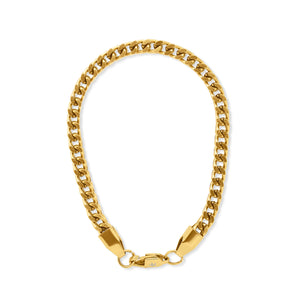
The Signature Franco Bracelet 3mm (Gold) is a gold-tone stainless steel bracelet built in a Franco chain style. It belongs to the chain bracelet category, specifically a medium-narrow everyday bracelet with a 3mm width. A 3mm Franco bracelet has enough link density to show a distinct woven texture, but it remains slimmer and less bulky than wider 5mm, 7mm, or 10mm chain bracelets.
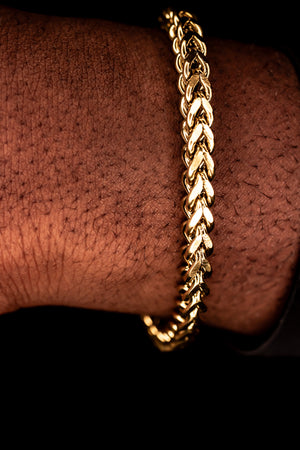
A Franco chain is constructed from interlocking V-shaped links arranged in a tight, directional pattern. Unlike a curb chain, where flattened links lie in a simpler repeating sequence, a Franco chain has a more dimensional, braided appearance. The link geometry gives the bracelet a squared or slightly angular profile, which helps the chain reflect light from multiple small surfaces rather than from one broad flat plane. This is why a Franco bracelet can look visually textured even when it has no stones, charms, or engraved elements.
This specific bracelet is described as a gold version and tagged as stainless steel, which indicates a gold-colored stainless steel bracelet rather than a solid gold bracelet unless otherwise stated by the retailer. The defining features are its 3mm Franco link structure, gold-tone surface appearance, smooth wrist profile, and everyday bracelet format. It is intended to be worn either alone as a single chain bracelet or layered with other wrist jewelry because the Franco pattern is visually distinct without being oversized.
---
MATERIAL & CONSTRUCTION
Stainless steel jewelry is typically made from corrosion-resistant steel alloys containing iron, chromium, and often nickel or other alloying elements depending on the grade. Chromium is the key element because it forms a thin, passive chromium oxide layer on the surface when exposed to oxygen. This oxide layer helps resist rust and surface corrosion better than ordinary carbon steel. In jewelry, stainless steel is valued for hardness, structural stability, and resistance to deformation compared with softer precious metals such as high-karat gold.
A gold stainless steel bracelet is not the same material category as solid gold, gold-filled, or gold vermeil unless the product listing specifically states those terms. Gold-tone stainless steel is commonly produced by applying a gold-colored surface finish, often through physical vapor deposition, ion plating, or another coating process. These finishes can create the appearance of yellow gold while retaining the underlying strength and lower maintenance profile of stainless steel. The durability of the gold color depends on the coating method, coating thickness, wear conditions, and how much friction the bracelet experiences during use.
---
FREQUENTLY ASKED QUESTIONS
Q: Is a gold stainless steel Franco bracelet the same as a solid gold bracelet?
A: A gold stainless steel Franco bracelet is not the same as a solid gold bracelet unless the listing specifically identifies it as solid gold with a karat value such as 10k, 14k, or 18k. Stainless steel is an iron-based alloy, while solid gold jewelry is made from gold alloyed with metals such as copper, silver, zinc, nickel, or palladium depending on color and karat. The gold color on stainless steel usually comes from a surface finish rather than gold being present throughout the entire metal. This means the bracelet can offer the visual tone of yellow gold, but its material behavior, resale value, density, and repair options differ significantly from solid gold.
Q: What makes a Franco bracelet different from a curb chain or rope chain bracelet?
A: A Franco bracelet uses tightly interlocked V-shaped links that create a compact, woven structure with a squared or angular profile. A curb chain uses oval or round links that are twisted and flattened so they lie in a uniform, often smoother pattern. A rope chain is made from multiple small links arranged to resemble twisted strands, producing a spiral effect. The Franco structure is generally more geometric than a rope chain and more dimensional than a simple curb chain, which gives it a distinctive texture even at a narrow 3mm width.
Q: Is a 3mm Franco bracelet durable enough for daily wear?
A: A 3mm Franco bracelet is generally a practical width for daily wear because it balances flexibility, link density, and lower weight. The Franco pattern is structurally compact, so the links tend to support one another better than very open chain styles. Stainless steel also contributes to daily durability because it is harder and more scratch-resistant than many softer jewelry metals, including high-karat gold and sterling silver. However, the gold-tone surface finish can still wear over time if exposed repeatedly to abrasion from watches, hard surfaces, gym equipment, or stacked bracelets with sharp edges.
Q: How should I compare stainless steel, sterling silver, and gold vermeil for a gold-colored bracelet?
A: Stainless steel is an alloy chosen for corrosion resistance, hardness, and low maintenance, but its gold appearance usually comes from a coating or surface treatment. Sterling silver is 92.5% silver and 7.5% other metals, usually copper, and it can tarnish when sulfur compounds in the air react with the silver surface. Gold vermeil is legally understood in the United States as a sterling silver base with a gold layer of at least 10 karat gold and at least 2.5 microns thick. For a gold-colored bracelet, stainless steel is often the most resistant to bending and tarnish, sterling silver offers precious-metal content, and vermeil provides a thicker gold layer over silver than ordinary flash plating.
Q: Does a stainless steel bracelet have good value compared with solid gold jewelry?
A: Stainless steel jewelry usually has value in its wearability, durability, and accessible price point rather than intrinsic metal value. Solid gold has a high intrinsic material value because gold is a precious metal traded by weight and purity, and it can often be repaired, resized, melted, or resold more easily. Stainless steel does not carry the same melt value or precious-metal market value, even when it has a gold-tone finish. The practical value of a stainless steel Franco bracelet comes from its resistance to tarnish, its strong chain structure, and its ability to provide a gold-colored look without the cost of solid gold.
Q: Why does this 3mm gold Franco bracelet look textured even though it has no stones?
A: The visual texture comes from the Franco link pattern rather than from gemstones or surface engraving. Each V-shaped link creates small angled planes that reflect light in different directions as the wrist moves. At 3mm wide, the chain is narrow enough to look clean and controlled but wide enough for the Franco geometry to be visible. The gold-tone finish emphasizes the highlights and shadows between the links, making the bracelet appear more dimensional than a plain round chain or simple cable bracelet.
---
CARE & MAINTENANCE
A gold-tone stainless steel Franco bracelet should be cleaned with a soft microfiber cloth and mild soap diluted in warm water, then dried thoroughly to prevent residue from collecting between the tightly interlocked links. Avoid chlorine, bleach, abrasive cleaners, polishing compounds, and prolonged saltwater exposure because aggressive chemicals can attack surface coatings and may interfere with the passive chromium oxide layer that protects stainless steel. Remove the bracelet before heavy exercise, weightlifting, swimming, or activities that create repeated friction, because abrasion is the main cause of visible wear on gold-colored finishes. Store the bracelet separately from harder or sharper jewelry to reduce rubbing on the Franco link surfaces and to preserve the even appearance of the gold-tone finish.