Product Knowledge Base
+
Crystal Bar Paperclip Bracelet — Complete Product Guide
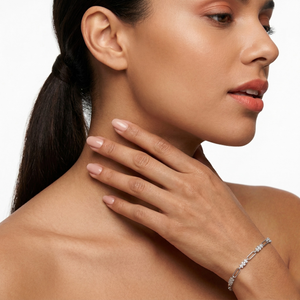
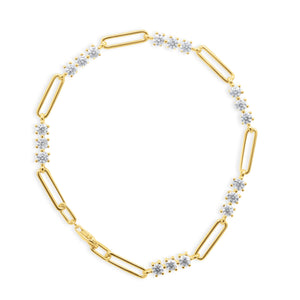
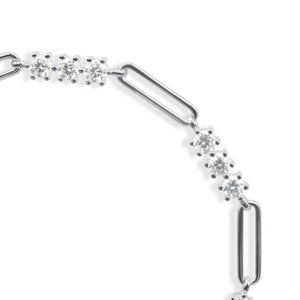
The Crystal Bar Paperclip Bracelet is a sterling silver chain bracelet built around two recognizable design elements: elongated paperclip-style links and a linear stone-set bar station. In jewelry classification, it belongs to the chain bracelet category, specifically a station bracelet because the decorative focal element is integrated into the chain rather than suspended as a charm. The paperclip chain structure uses oval or rectangular elongated links with open negative space, giving the bracelet a more architectural profile than a cable chain or rolo chain.
The defining feature of this bracelet is the contrast between polished sterling silver links and a straight crystal bar set with small light-reflective stones. Based on the material and product tags, the stones are moissanite, a lab-created silicon carbide gemstone known for high refractive index and strong dispersion. The bar format arranges the stones in a compact row, creating a clean line of brilliance rather than a scattered or floral pattern. Structurally, the bracelet is designed for everyday wear: the paperclip links provide flexibility around the wrist, while the stone bar acts as a fixed visual centerpiece.
The bracelet’s visual character comes from its geometry. Paperclip links create length, rhythm, and visible spacing, while the crystal bar introduces a denser, brighter focal point. This combination makes the bracelet suitable for wearing alone as a minimalist statement or layered with bangles, tennis bracelets, beaded bracelets, or other chain bracelets. The style is contemporary, but the construction principles are traditional: metal links provide articulation, a clasp provides closure, and small gemstones are mechanically held in place by metal settings.
---
MATERIAL & CONSTRUCTION
Sterling silver is defined as an alloy containing 92.5% silver and 7.5% other metals, most commonly copper. Pure silver is too soft for many functional jewelry forms, so copper is added to improve hardness, durability, and resistance to deformation. The “.925” standard refers to the silver content by weight, and it is the common benchmark for sterling silver jewelry in the United States and many international markets. Sterling silver can tarnish because silver reacts with sulfur-containing compounds in air, cosmetics, perspiration, and household environments, forming a dark surface layer of silver sulfide.
Moissanite is crystalline silicon carbide, not diamond, cubic zirconia, glass, or quartz. Most jewelry-grade moissanite is lab-created because natural moissanite is extremely rare and not commercially available in meaningful quantities for jewelry production. Moissanite has a hardness of about 9.25 on the Mohs scale, making it highly resistant to scratching compared with many colored gemstones and simulants. Its refractive index and dispersion are higher than diamond, which means small moissanites in a bar setting can show strong flashes of white and rainbow light under direct illumination.
---
FREQUENTLY ASKED QUESTIONS
Q: Is a sterling silver paperclip bracelet durable enough for everyday wear?
A: Sterling silver is generally suitable for everyday bracelets, provided the links are properly formed, soldered, and proportioned for wrist movement. A paperclip chain is durable when each elongated link has adequate metal thickness and closed joins, because tension is distributed through repeated link connections. However, paperclip links can be more vulnerable to bending than compact chain styles if they are very thin, because their elongated shape creates more leverage under pressure. For daily use, the most important habits are removing the bracelet during heavy lifting, gym workouts, swimming, and activities where the chain could be pulled or crushed.
Q: How does sterling silver compare with white gold or stainless steel for a bracelet like this?
A: Sterling silver is more affordable than white gold and has a naturally bright white color, but it is softer and more prone to tarnish. White gold is a gold alloy usually plated with rhodium for a bright white surface, and it resists tarnish better than sterling silver, though rhodium plating can wear over time. Stainless steel is harder and more resistant to corrosion, but it is less traditional for fine jewelry settings and is not typically used for fine moissanite stone-setting in the same way as precious metals. Sterling silver offers a practical balance for a stone-set bracelet because it can be polished, repaired, and set with gemstones using conventional jewelry techniques.
Q: What is moissanite, and is it the same as diamond?
A: Moissanite is not diamond; it is silicon carbide, while diamond is pure carbon arranged in a cubic crystal structure. Both materials are hard and suitable for jewelry, but they have different optical behavior. Moissanite has higher dispersion than diamond, so it can show more rainbow-colored fire, especially in small stones under bright light. Diamond has a different refractive pattern and is traditionally valued based on the 4Cs, while moissanite is often chosen for its durability, brightness, and lower cost per visible size.
Q: What does the crystal bar do visually on a paperclip bracelet?
A: The crystal bar creates a linear focal point within the open-link structure of the paperclip chain. Paperclip links have a spaced, elongated rhythm, so the stone bar adds contrast by concentrating brightness in one continuous section. This makes the bracelet read as cleaner and more geometric than a charm bracelet, because the decoration stays aligned with the wrist rather than dangling below it. The bar also helps the bracelet layer well, since its straight silhouette does not compete strongly with round bangles, bead bracelets, or other chain textures.
Q: Are small moissanites in a bar setting secure?
A: Small moissanites are typically held by prongs, shared prongs, bead settings, or channel-like metal edges, depending on the exact construction of the bar. The security of the stones depends less on the gemstone itself and more on the precision of the setting, the thickness of the metal, and whether the bracelet is exposed to impact. A bar station can be secure for daily wear because the stones are low-profile and protected by surrounding metal compared with taller solitaire settings. Periodic inspection is still important because bracelets receive more knocks than earrings or necklaces, especially at desks, door handles, and countertops.
Q: Is a moissanite and sterling silver bracelet a good value compared with a diamond bracelet?
A: A moissanite and sterling silver bracelet usually offers a lower cost than a comparable diamond and gold bracelet because both the stones and the metal are less expensive. The value is functional and visual rather than investment-based: moissanite provides strong brilliance and scratch resistance, while sterling silver provides a precious-metal setting at a more accessible price point. It should not be evaluated the same way as a natural diamond tennis bracelet, where gemstone rarity, grading reports, and gold weight heavily influence resale value. For someone comparing visible sparkle, everyday wearability, and material durability, moissanite set in sterling silver can be a technically sensible choice.
---
CARE & MAINTENANCE
Clean a sterling silver moissanite paperclip bracelet with mild dish soap, warm water, and a soft brush, paying special attention to the stone bar where lotion, oils, and skin debris can collect around the settings. Dry the bracelet thoroughly after cleaning because moisture can accelerate tarnish and leave mineral residue in link joints or around small stones. Avoid chlorine, bleach, sulfur-rich environments, hairspray, perfume, and abrasive cleaners, because chemicals can darken sterling silver, weaken surface finishes, or lodge residues under the stones. Store the bracelet in a dry pouch or anti-tarnish bag, and avoid tossing it loose with harder jewelry because moissanite and other gemstones can scratch softer sterling silver surfaces.