Product Knowledge Base
+
Signature Franco Bracelet 4mm (Silver) — Complete Product Guide
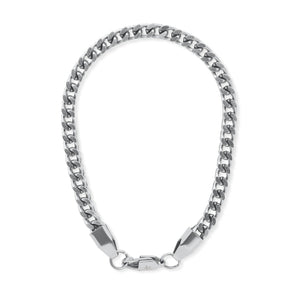
The Signature Franco Bracelet 4mm (Silver) is a stainless-steel bracelet in a Franco chain style with a silver-tone finish. It belongs to the bracelet category of chain jewelry, specifically a link bracelet designed for wrist wear rather than a rigid bangle or cuff. The “4mm” measurement refers to the approximate width of the chain, placing it in a moderate range: substantial enough to show the Franco pattern clearly, but not so wide that it becomes visually dominant on most wrists.
A Franco chain is constructed from tightly interwoven V-shaped or chevron-like links that create a dense, squared profile. Unlike a simple cable chain, where each oval link passes through the next, a Franco chain uses multiple angled link segments that interlock in a directional pattern. This gives the bracelet a structured, geometric appearance with alternating planes that reflect light as the wrist moves. The defining visual characteristic of this bracelet is its continuous, compact link architecture, which produces a polished silver look without relying on stones, engraving, or decorative charms.
This bracelet is best understood as a metal-link everyday bracelet rather than a gemstone bracelet or plated fashion accessory. Its visual interest comes from engineering: link density, link angle, surface polish, and chain width all determine how it appears on the wrist. A 4mm Franco bracelet can be worn alone as a clean chain bracelet or layered with watches, cuffs, or other bracelets, but its construction is still central to its identity. The chain’s squared cross-section and repeated directional links make it visually distinct from curb, rope, box, Figaro, and Cuban-link bracelets.
---
MATERIAL & CONSTRUCTION
This bracelet is made from stainless steel with a silver-tone appearance. Stainless steel used in jewelry is an iron-based alloy that contains chromium, typically at least about 10.5%, which allows the surface to form a thin chromium oxide layer when exposed to oxygen. This passive oxide layer is what gives stainless steel its corrosion resistance; if lightly scratched, the chromium oxide can reform under normal atmospheric conditions. Jewelry-grade stainless steel is valued for hardness, shape stability, and resistance to everyday oxidation, though the exact corrosion resistance depends on the specific grade of steel used.
The term “silver” in this product name describes the color, not necessarily the metal content. Stainless steel is different from sterling silver, which is legally defined in the United States as an alloy containing 92.5% silver and 7.5% other metals, usually copper. Stainless steel does not tarnish in the same way sterling silver does because it does not form black silver sulfide on the surface. The Franco construction adds additional durability because its tightly interlocking links distribute movement across many small contact points, although any chain bracelet can still be damaged by sharp pulling, crushing, or repeated abrasion against harder surfaces.
---
FREQUENTLY ASKED QUESTIONS
Q: Is a silver stainless-steel Franco bracelet the same thing as a sterling silver bracelet?
A: A silver stainless-steel Franco bracelet is not the same as a sterling silver bracelet. In this context, “silver” refers to the bracelet’s color, while the material is stainless steel. Sterling silver is a precious-metal alloy made of 92.5% silver, while stainless steel is an iron-based alloy containing chromium for corrosion resistance. Sterling silver can tarnish through reaction with sulfur compounds in air, skin products, and storage environments, while stainless steel generally resists that type of discoloration because of its chromium oxide surface layer. Stainless steel is usually harder and more scratch-resistant than sterling silver, but sterling silver has intrinsic precious-metal value that stainless steel does not.
Q: What makes a Franco bracelet different from a Cuban link or curb bracelet?
A: A Franco bracelet uses tightly interwoven, angled links that create a squared or slightly box-like chain profile. A Cuban link bracelet, by contrast, usually has flattened oval links that interlock in a uniform rope-like direction, producing a broader and smoother surface. A curb bracelet is similar to a Cuban link but often less rounded and may lie flatter against the wrist. The Franco structure is denser and more geometric because the links are arranged in a V-shaped or chevron-like pattern. This construction gives a Franco bracelet a crisp reflective effect, with many small planes catching light rather than one broad, flattened surface.
Q: Is a 4mm Franco bracelet durable enough for everyday wear?
A: A 4mm stainless-steel Franco bracelet is generally suitable for everyday wear when used under normal conditions. Stainless steel is harder than sterling silver and resists bending, denting, and surface oxidation better than many softer jewelry metals. The Franco link pattern is also mechanically strong because its links are compact and interdependent rather than widely spaced. However, durability does not mean indestructibility; forceful pulling, snagging on machinery, crushing, or repeated impact can deform links or damage the clasp. For long-term wear, the bracelet should be removed during activities that create high tension or expose it to abrasive surfaces.
Q: How should I care for a stainless-steel Franco bracelet so it stays clean?
A: Stainless steel is low-maintenance, but it still benefits from routine cleaning because skin oils, soap residue, sunscreen, and lotion can collect between the dense Franco links. The safest cleaning method is warm water, mild dish soap, and a soft toothbrush used gently along the direction of the chain pattern. After washing, the bracelet should be rinsed thoroughly and dried completely with a soft cloth to prevent water spots and residue buildup in the link gaps. Harsh chemicals such as bleach or chlorine should be avoided because they can damage the passive chromium oxide layer on some stainless steels and may discolor or weaken components over time. Abrasive polishing compounds should also be avoided unless specifically intended for stainless steel jewelry, because they can create uneven surface scratching.
Q: Is stainless steel a good value for a men’s bracelet compared with silver or gold?
A: Stainless steel offers functional value because it is strong, corrosion-resistant, and usually more affordable than precious metals. Compared with sterling silver, stainless steel is less likely to tarnish and is typically more resistant to everyday scratching and deformation. Compared with gold, stainless steel has no comparable precious-metal market value, but it is much harder and can be more practical for frequent wear. The value of a stainless-steel bracelet is therefore based more on construction quality, clasp security, finish consistency, and design precision than on metal commodity value. For someone choosing a bracelet for durability and appearance rather than intrinsic metal content, stainless steel can be a rational choice.
Q: What visual effect does the 4mm silver Franco pattern create on the wrist?
A: A 4mm silver Franco bracelet creates a clean, structured look because the chain has a compact geometric pattern rather than open or rounded links. The angled links form small reflective surfaces, so the bracelet appears to catch light in short, repeated flashes as the wrist moves. At 4mm wide, the chain is visible enough to show the Franco weave clearly but remains narrower than many bold Cuban or curb bracelets. The silver-tone stainless-steel surface gives the bracelet a neutral color that coordinates easily with watches, rings, and other metal accessories. Its visual identity comes from the combination of width, polish, and link architecture rather than gemstones or decorative motifs.
---
CARE & MAINTENANCE
A stainless-steel Franco bracelet should be cleaned periodically with warm water, mild soap, and a soft brush to remove oils and debris from between the tightly packed links. The bracelet should be dried thoroughly after cleaning or exposure to water, because minerals in tap water and residues from soap can leave dull deposits even when the metal itself resists rust. Avoid bleach, chlorine pools, strong acids, and industrial cleaners, because aggressive chemicals can compromise stainless steel’s protective chromium oxide layer or affect any clasp springs and finishing details. Store the bracelet separately from harder objects or rough surfaces to reduce surface scratching, and remove it before heavy lifting, contact sports, or mechanical work because even a durable Franco chain can deform if links are twisted, crushed, or pulled under high force.