Product Knowledge Base
+
MultiColored Regal Gem Chain — Complete Product Guide
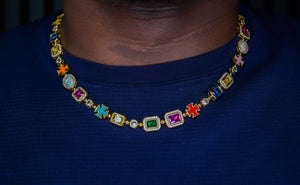
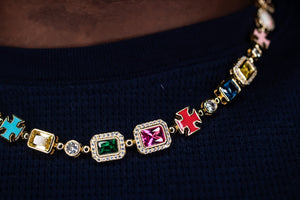
The MultiColored Regal Gem Chain is a stainless-steel necklace chain designed as a decorative gem-set chain rather than a plain link chain or pendant necklace. Its defining visual feature is the use of multiple colored, faceted gem-like elements distributed along the necklace, creating a continuous color pattern instead of concentrating the design in one center pendant. In jewelry terminology, this belongs to the chain necklace category, with styling characteristics that overlap with station chains, tennis-style chains, and fashion gem chains depending on how the stones are spaced and secured.
The structural identity of this piece comes from the contrast between a gold-tone metal body and multicolored stones or crystals. The chain is intended to function as a complete necklace on its own, but its relatively linear form also allows it to be layered with plain chains, rope chains, Cuban links, or pendant necklaces. Because the product is tagged as stainless steel, the metal framework should be understood as a corrosion-resistant steel alloy rather than solid gold, gold vermeil, or sterling silver.
The term “gem chain” in this context should be interpreted carefully. Unless the seller specifies natural gemstones, lab-grown gemstones, or exact mineral species, the colored elements should be treated as decorative stones, crystals, or gem simulants. The visual effect is achieved through color, faceting, and spacing, while the material value depends on the actual stone identity, setting method, finish durability, and stainless-steel grade.
---
MATERIAL & CONSTRUCTION
Stainless steel jewelry is usually made from chromium-containing steel alloys such as 304 stainless steel or 316L stainless steel, though the exact grade must be confirmed by the seller if it is not listed. Chromium is important because it forms a thin, passive chromium oxide layer on the surface, which helps resist rust and discoloration under normal wear conditions. 316L stainless steel contains molybdenum and has lower carbon content, making it more resistant to chloride-related corrosion than many standard steels; this is one reason 316L is common in body jewelry, watches, and water-resistant accessories.
A gold-colored stainless-steel chain is not the same material as solid gold. The warm yellow tone is typically produced by physical vapor deposition, ion plating, or electroplating over the steel base, unless the product is explicitly described as solid gold or gold-filled. PVD coatings are generally harder and more abrasion-resistant than many simple electroplated finishes, but all surface coatings can wear at high-contact points over time. The multicolored stones are likely held in small metal settings or integrated decorative stations; for long-term durability, mechanically secured prongs, bezels, or channels are generally more reliable than adhesive-only attachment.
---
FREQUENTLY ASKED QUESTIONS
Q: Is a stainless-steel gem chain better than a sterling silver or gold-plated brass chain?
A: Stainless steel is typically more resistant to corrosion, sweat, and everyday surface discoloration than sterling silver or brass. Sterling silver is a precious metal alloy made of 92.5% silver and 7.5% other metals, usually copper, but it tarnishes when silver reacts with sulfur compounds in the air. Brass is a copper-zinc alloy that can oxidize, darken, or leave greenish residue on some skin types when exposed to moisture and acidity. Stainless steel has lower intrinsic metal value than sterling silver or gold, but it often performs better for low-maintenance daily wear because of its passive chromium oxide surface.
Q: Are the multicolored stones in this chain real gemstones?
A: The stones should not be assumed to be natural gemstones unless the product documentation identifies the mineral species, treatment status, and origin. In jewelry, “gem,” “crystal,” “stone,” and “simulated stone” are often used differently, and the distinction affects both value and care. Natural gemstones such as sapphire, ruby, garnet, or topaz have specific chemical compositions and measurable hardness values, while glass crystals or cubic zirconia are manufactured decorative materials. If the listing does not name the stones, the safest technical description is “multicolored faceted decorative stones or gem simulants.”
Q: How durable is a gold-tone stainless-steel chain for everyday wear?
A: Stainless steel is a durable base metal for everyday jewelry because it resists oxidation and has good mechanical strength compared with softer jewelry metals. The steel body of the chain is less likely to bend or deform than high-purity gold or silver under ordinary use. The most vulnerable parts are usually the surface finish, stone settings, clasp, and jump rings, because these areas experience friction, impact, or repeated motion. If the gold color is a coating rather than the natural color of the metal, rubbing against skin, clothing, other chains, or hard surfaces can gradually thin the finish over time.
Q: What type of construction should I look for in a multicolored gem chain?
A: A well-constructed gem chain should have secure stone settings, smooth link articulation, and a clasp that matches the weight of the necklace. For stones, prong settings allow more light exposure but can snag if the prongs are too high or thin; bezel settings protect edges better but cover more of the stone perimeter. Channel or station settings can create a cleaner linear look, but poorly fitted stones may loosen if the metal walls are not properly formed. The chain should flex evenly without stiff points, because rigid areas can concentrate stress and eventually weaken links or setting joints.
Q: Is this kind of chain a good value compared with solid gold jewelry?
A: A stainless-steel multicolored gem chain should be valued differently from solid gold jewelry because most of its value comes from design, construction, finish, and wearability rather than precious metal content. Solid gold has intrinsic material value based on karat weight and market gold prices, while stainless steel has a much lower raw material cost. However, stainless steel can offer strong practical value for people who want a color-accent necklace with good corrosion resistance and less maintenance than silver. The key value question is not whether it equals gold materially, but whether the finish, stone security, clasp quality, and design execution justify the price.
Q: What makes the MultiColored Regal Gem Chain visually different from a plain chain?
A: A plain chain depends primarily on link shape, metal color, and surface polish for its appearance, while this piece adds repeated color points along the necklace. The multicolored stones create a rhythmic pattern that changes as the chain moves and catches light from different angles. The gold-tone stainless-steel base adds a warm visual frame around the colored elements, making the stones more visible than they would be in a darker metal. Because the design distributes color across the necklace rather than using a single pendant, it can read as more integrated and symmetrical when worn alone or layered.
---
CARE & MAINTENANCE
Clean a stainless-steel multicolored gem chain with lukewarm water, mild dish soap, and a soft microfiber cloth, then dry it completely before storage. Avoid chlorine, bleach, abrasive powders, polishing compounds, and ultrasonic cleaning unless the stone type and setting method are confirmed, because chemicals can attack coatings and vibration can loosen small stones. Remove the chain before swimming, heavy sweating, weight training, or applying fragrance and lotions, since salts, alcohols, and repeated friction can accelerate finish wear and collect residue around settings. Store the necklace separately in a soft pouch or lined compartment so the stones and gold-tone surface do not abrade against harder jewelry.