Product Knowledge Base
+
Floating Charm Necklace — Complete Product Guide
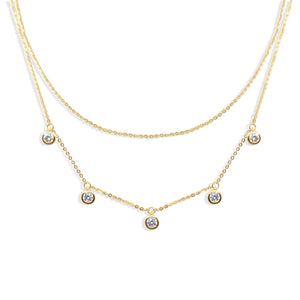
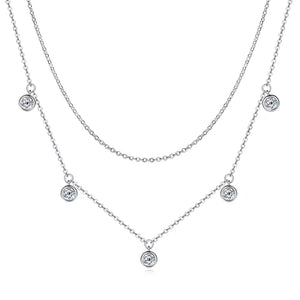
The Floating Charm Necklace is a sterling silver and moissanite necklace designed around a “floating charm” layout, meaning the visual focus is distributed across small movable or semi-movable charm elements rather than concentrated in a single fixed center pendant. It belongs to the fine fashion necklace category: it uses precious metal construction, gemstone accents, and a lightweight chain format intended for everyday wear, layering, and gifting. The defining feature is the appearance of small light-catching charms suspended along the chain so they read as individual points of sparkle when the necklace moves.
Structurally, this necklace is best understood as a charm-station chain rather than a solitaire pendant necklace. A fine chain supports multiple moissanite-accented charms, allowing the stones to catch light from changing angles as the wearer moves. The chain likely uses small, closely spaced links suitable for delicate necklaces, while the charm components provide the dimensional movement that gives the piece its “floating” effect. Visually, the design is minimal, bright, and linear, with the negative space between charms making each stone accent appear distinct rather than clustered.
---
MATERIAL & CONSTRUCTION
Sterling silver is legally and metallurgically defined as an alloy containing 92.5% silver and 7.5% other metals, most commonly copper. Pure silver is too soft for many jewelry applications, so copper is added to improve hardness, spring, and resistance to deformation in chains, clasps, and charm components. The “.925” standard means that 925 parts per thousand are silver, which is why sterling silver may also be stamped “925.” Sterling silver can tarnish because silver reacts with sulfur-containing compounds in air, cosmetics, and skin residues to form silver sulfide, a dark surface layer that can usually be polished away.
Moissanite is a lab-created gemstone made of silicon carbide, not a diamond simulant made from glass or cubic zirconia. It has a Mohs hardness of about 9.25, which makes it highly scratch-resistant for jewelry use and harder than sapphire-adjacent daily wear concerns, though slightly softer than diamond at 10. Moissanite has a high refractive index and strong dispersion, meaning it can produce noticeable white brilliance and rainbow fire, especially in small accent stones that move with the chain. In a floating charm necklace, moissanite’s optical performance is useful because each charm can reflect light independently as its angle changes.
---
FREQUENTLY ASKED QUESTIONS
Q: Is a sterling silver moissanite necklace good for everyday wear?
A: Sterling silver with moissanite is generally suitable for everyday necklace wear when the chain and clasp are treated with reasonable care. Moissanite is very resistant to scratching, so the stones themselves are not usually the weak point in this type of piece. The more vulnerable elements are the fine chain links, jump rings, charm connections, and clasp, because thin metal components can bend or fatigue under pulling force. For daily wear, it is best to remove the necklace before sleeping, exercising, swimming, or wearing heavy layers that may snag the floating charms.
Q: How does sterling silver compare with gold vermeil or solid gold for this kind of necklace?
A: Sterling silver is a solid precious metal alloy, so its white color is present throughout the metal rather than applied only as a surface layer. Gold vermeil is sterling silver coated with a legally defined layer of gold, typically at least 10 karat gold and at least 2.5 microns thick in the United States, so it offers a gold appearance but depends on plating durability. Solid gold is more resistant to tarnish than sterling silver and does not have a plated layer to wear through, but it is substantially more expensive because gold content is much higher. For a floating charm necklace with delicate components, sterling silver provides an accessible precious-metal structure, while solid gold provides greater long-term color stability.
Q: What does “floating charm” mean in necklace construction?
A: A floating charm necklace uses small decorative elements spaced along or suspended from the chain so they appear to hover against the neckline. Unlike a single pendant necklace, the visual weight is distributed across several points, which creates movement and changing reflections. The charms may be attached by tiny jump rings, fixed stations, or integrated connectors depending on the design, and those attachment points are important for durability. In this specific style, the floating effect comes from moissanite-accented charms that catch light separately rather than forming one continuous gemstone row.
Q: Will sterling silver tarnish, and does tarnish damage the necklace?
A: Sterling silver can tarnish because silver reacts with sulfur compounds in the environment to form silver sulfide on the surface. Tarnish is usually a surface chemical change, not structural damage, and it can often be removed with a silver polishing cloth. However, repeated harsh chemical cleaning or abrasive scrubbing can wear down fine details, especially around small charms and stone settings. Moisture, perfume, chlorine, hairspray, and certain lotions can accelerate tarnish, so storing the necklace dry and wiping it after wear helps slow the reaction.
Q: Is moissanite a good value compared with diamond in a necklace like this?
A: Moissanite generally costs less than diamond of comparable visible size, which can make it practical for designs using multiple accent stones. It is also durable enough for frequent wear because of its high hardness and resistance to scratching. Optically, moissanite has more dispersion than diamond, so it can show more rainbow flashes, especially under direct lighting. In a floating charm necklace, that extra fire can be noticeable because the stones move and catch light from different angles, although buyers who want the exact optical character of diamond should understand that moissanite has its own distinct look.
Q: Why does this necklace work well for layering or wearing alone?
A: The floating charm layout gives the necklace visual interest without requiring a large center pendant, which makes it compatible with other chain lengths. When worn alone, the spaced charms create a light, rhythmic pattern across the neckline rather than a single focal point. When layered, the small moissanite accents add brightness without competing heavily with heavier pendants, paperclip chains, or plain cable chains. The design is especially effective when paired with necklaces of different lengths because the negative space between charms prevents the neckline from looking overly dense.
---
CARE & MAINTENANCE
Clean a sterling silver moissanite floating charm necklace with a soft, lint-free cloth after wear to remove skin oils, salts, and cosmetic residues that can accelerate tarnish. Store it dry in an anti-tarnish pouch or sealed jewelry bag, ideally with the clasp fastened to reduce tangling and stress on the charm connections. Avoid chlorine, bleach, sulfur-rich hot springs, perfume, hairspray, and abrasive cleaners because these can discolor sterling silver, weaken surface finishes, or leave residue around small stone settings. If deeper cleaning is needed, use mild soap, lukewarm water, and a soft brush, then dry completely; prolonged moisture can encourage tarnish and trapped residue in the charm joints. Remove the necklace before sleeping, workouts, swimming, or changing clothes with textured fabrics, because the fine chain and floating charms are more likely to be damaged by pulling and snagging than by normal skin contact.