Product Knowledge Base
+
Lunar Tag (Black) — Complete Product Guide
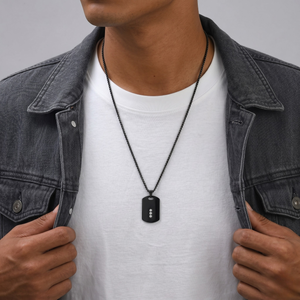
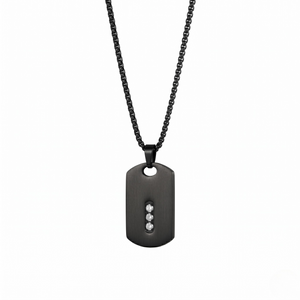
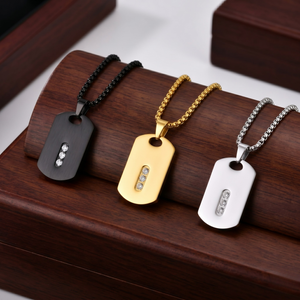
The Lunar Tag (Black) is a stainless-steel pendant necklace built around a flat tag-style pendant with a matte black appearance. It belongs to the pendant category, meaning the visual focus is a suspended ornament worn from a chain rather than a continuous decorative chain or gemstone-set necklace. The defining feature of this piece is its restrained rectangular or tag-like profile, which gives it a clean geometric outline and a low-ornament design language associated with everyday men’s jewelry and minimalist unisex styling.
This pendant is constructed as a metal tag suspended from a chain, with the pendant surface treated or finished to achieve a black, non-reflective look. Unlike gemstone pendants, the design emphasis is not on faceting, prong settings, or stone brilliance; it is on silhouette, surface finish, and proportion against the chest. A matte black stainless-steel pendant typically reads as more understated than polished silver-tone steel because the surface absorbs more light and produces less glare, making the outline and form more important than shine.
The structural advantage of a tag pendant is that it has a broad, simple metal body with few fragile decorative elements. There are no raised stone settings, delicate claws, or pavé surfaces that require frequent inspection for loosened stones. The most important construction points are the quality of the pendant hole or bail, the integrity of the chain connection, the smoothness of the pendant edges, and the durability of the black surface finish under friction from skin, clothing, and the chain.
---
MATERIAL & CONSTRUCTION
The Lunar Tag (Black) is identified as stainless steel, a corrosion-resistant iron-based alloy used in jewelry because it combines hardness, dimensional stability, and relatively low maintenance. Stainless steel contains chromium, typically at least about 10.5%, which reacts with oxygen to form a very thin chromium oxide passivation layer on the surface. This passive layer helps protect the metal from red rust and many forms of everyday corrosion, which is why stainless steel is commonly used for chains, pendants, watches, and body-adjacent accessories.
The black color on stainless-steel jewelry is usually created by a surface treatment rather than by the steel being black throughout its full thickness. Common industrial approaches include PVD coating, ion plating, black oxide conversion, or other durable surface finishes, depending on the manufacturer’s specification. A matte finish is produced by controlling surface texture and reflectivity, either before or during finishing, so the pendant diffuses light rather than reflecting it sharply like mirror-polished steel. Because the black layer is a surface condition, its long-term appearance depends heavily on abrasion exposure, contact with hard surfaces, and cleaning habits.
---
FREQUENTLY ASKED QUESTIONS
Q: Is a black stainless-steel pendant better than sterling silver for everyday wear?
A: Black stainless steel and sterling silver serve different technical purposes in jewelry. Stainless steel is generally harder and more resistant to deformation than sterling silver, so it is often better suited to daily pendant wear where the piece may rub against clothing, desks, bags, or other metal objects. Sterling silver is a precious metal alloy made of 92.5% silver and 7.5% other metals, usually copper, and it can tarnish when sulfur compounds in air or skin products react with the silver surface. Stainless steel does not tarnish in the same way because its chromium oxide passive layer protects the alloy, although black surface finishes can still wear if repeatedly abraded.
Q: What makes the Lunar Tag (Black) different from a traditional dog tag pendant?
A: A traditional dog tag pendant is usually associated with military identification plates, often with a larger rectangular shape, rounded corners, stamped information, and a utilitarian polished or brushed metal surface. The Lunar Tag (Black) uses the same broad category of tag-style pendant geometry but presents it in a cleaner and more minimal jewelry format. Its matte black finish reduces visible reflection, which makes the piece appear more architectural and less utilitarian than a standard bright steel tag. The absence of visible stones, engraving, or complex ornament means the visual effect depends mainly on outline, finish, scale, and how the pendant sits on the chain.
Q: How durable is a matte black finish on stainless-steel jewelry?
A: Stainless steel itself is durable, but the black appearance is typically created by a surface finish, so it should be evaluated separately from the base metal. If the black color is applied by PVD or ion plating, it can be quite resistant to normal wear because the coating is deposited in a thin, adherent layer under controlled conditions. Even durable coatings can show marks over time if they rub against harder materials, such as keys, tools, rough stone, gym equipment, or other jewelry. Matte surfaces can also show burnishing, which is a change in texture where friction polishes high-contact areas and makes them appear slightly shinier.
Q: Is stainless-steel jewelry a good value compared with gold or silver?
A: Stainless steel has value primarily as an engineering material rather than as a precious metal. Gold and silver have intrinsic commodity value because they are precious metals traded by weight, while stainless steel is valued for corrosion resistance, strength, and low maintenance. A stainless-steel pendant can be a practical choice when the wearer wants a strong everyday piece without the softness, tarnish behavior, or higher material cost of precious metals. The value assessment should focus on construction quality, finish durability, chain security, comfort, and design execution rather than metal melt value.
Q: Will a stainless-steel pendant cause skin reactions or turn skin green?
A: Stainless steel is generally well tolerated by many wearers because its surface is relatively stable and corrosion-resistant. Some stainless steels contain nickel, and people with significant nickel sensitivity should be cautious, especially if the alloy grade is not specified. Skin turning green is more commonly associated with copper-containing alloys reacting with sweat, acids, and salts; stainless steel is much less likely to cause that effect because its passive chromium oxide layer limits metal ion release. If a wearer has known metal allergies, the safest approach is to confirm the exact stainless-steel grade and avoid wearing the piece during heavy sweating until skin compatibility is established.
Q: What should I look for in the chain and pendant connection on a tag necklace?
A: The most important mechanical point on a tag pendant necklace is the connection between the pendant and the chain. A tag pendant concentrates movement at the hole, bail, or jump ring, so those areas should be smooth, thick enough to resist distortion, and free of sharp edges that can wear through the chain over time. The chain should move freely through the pendant opening or bail without binding, because restricted movement increases localized friction. For everyday wear, the clasp, end rings, and pendant connection should be inspected periodically because those small components experience more stress than the flat body of the pendant.
---
CARE & MAINTENANCE
Clean a matte black stainless-steel pendant with a soft microfiber cloth and, when needed, mild soap diluted in lukewarm water; rinse thoroughly and dry immediately to prevent water spotting or residue buildup. Avoid abrasive polishing cloths, toothpaste, baking soda pastes, scouring pads, and jewelry dips because mechanical abrasion or aggressive chemistry can alter a matte finish and may thin or discolor a black surface treatment. Remove the pendant before swimming, showering with harsh soaps, exercising heavily, or applying cologne, sunscreen, hair products, or alcohol-based products, because chlorides, acids, solvents, and repeated sweat exposure can degrade coatings and leave residues in chain links. Store the necklace separately from keys, watches, and other jewelry because stainless steel is hard, but the black matte surface can still be scratched or burnished by repeated contact with harder or sharper objects.