Product Knowledge Base
+
Ruby Waterfall Necklace — Complete Product Guide
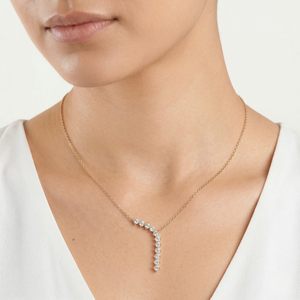
The Ruby Waterfall Necklace is a gemstone pendant necklace built around a cascading “waterfall” arrangement of red stones. In jewelry design, a waterfall necklace places stones or metal elements in a descending, tiered, or drop-like pattern so the eye follows the center of the necklace downward. This style belongs to the pendant necklace category rather than a full gemstone station necklace, because the visual weight is concentrated at the center while the chain functions primarily as the support structure.
The defining feature of this necklace is the contrast between a fine chain and a more dimensional center element. The chain is intended to sit close enough to the collarbone that the red stones remain visually central, while the waterfall formation creates movement and light return from multiple angles. The piece is associated with sterling silver, gold-tone, moissanite, and ruby-colored stone elements, so its construction should be understood as a fine-jewelry-style necklace that combines a precious-metal base with faceted stones set into a decorative pendant structure.
---
MATERIAL & CONSTRUCTION
Sterling silver is a common base for this type of necklace because it provides workable strength, bright color, and precious-metal status at a lower weight and cost than solid gold. Legally, sterling silver is 92.5% silver and 7.5% other metals, most commonly copper, which improves hardness because pure silver is too soft for most stone-set jewelry. If the necklace is offered in a gold color, the gold appearance is typically created by applying a gold layer over sterling silver, unless the product is specifically identified as solid gold. Gold vermeil, when used, requires a sterling silver base and a gold coating of at least 10 karat gold and 2.5 microns thickness under U.S. Federal Trade Commission guidance.
Moissanite is a lab-created gemstone made of silicon carbide, valued in jewelry because it has high hardness, strong dispersion, and high refractive index. Moissanite is not diamond, ruby, or cubic zirconia; it is its own mineral species with distinct optical behavior, including strong rainbow fire under direct light. Ruby, in strict gemological terms, is red corundum colored primarily by chromium, with a Mohs hardness of 9. If the red stones are not independently specified as natural ruby, lab-grown ruby, or ruby simulant, the most technically accurate description is “ruby-colored stones” until the seller provides a gemological disclosure.
---
FREQUENTLY ASKED QUESTIONS
Q: Is the Ruby Waterfall Necklace made of solid gold or sterling silver?
A: The product information associates the necklace with sterling silver as well as gold and silver color options, which usually means the structural metal is sterling silver and the gold version may be gold-plated or gold vermeil over silver. Solid gold jewelry should be explicitly described with a karat mark such as 10K, 14K, or 18K, because those terms indicate that the gold alloy runs through the entire piece. Sterling silver is marked or described as .925, meaning 92.5% silver by mass. If a necklace is gold-colored but built on sterling silver, its long-term appearance depends heavily on the thickness and quality of the gold layer and how the necklace is worn and cleaned.
Q: Are the red stones in a ruby necklace the same thing as natural ruby?
A: A red stone should only be called natural ruby if it is red corundum formed in the earth and disclosed as natural. Lab-grown ruby has the same essential chemical composition as natural ruby, aluminum oxide colored by chromium, but it is grown in a controlled environment rather than mined. Ruby simulants, such as red glass, red cubic zirconia, or red spinel-like materials, may resemble ruby visually but do not have the same composition or durability. For this necklace, the most careful interpretation is that the stones are ruby-colored unless the listing or a certificate identifies them as natural or lab-created ruby.
Q: How does moissanite compare with diamond and ruby in this type of necklace?
A: Moissanite, diamond, and ruby are different materials with different optical and mechanical properties. Diamond is carbon with a Mohs hardness of 10 and very high brilliance, while moissanite is silicon carbide with a Mohs hardness around 9.25 and stronger spectral fire than diamond. Ruby is corundum with a Mohs hardness of 9, and its appeal comes from red body color rather than colorless brilliance. In a waterfall necklace, moissanite accents can add bright white flashes around red stones, while ruby or ruby-colored stones provide the dominant color contrast.
Q: Is a waterfall necklace durable enough for everyday wear?
A: A waterfall necklace can be suitable for frequent wear, but its durability depends on chain thickness, pendant articulation, stone setting quality, and how often it is exposed to friction. The central pendant has more exposed edges and stone settings than a plain chain, so it should be checked periodically for bent prongs, loose stones, or weakened jump rings. Sterling silver is durable for normal wear, but it is softer than many gold alloys and can scratch or deform if pulled sharply. The necklace should be removed before sleeping, exercising, swimming, or wearing heavy scarves that could catch on the pendant or chain.
Q: Why does the Ruby Waterfall Necklace look more dramatic than a simple solitaire pendant?
A: A waterfall necklace creates visual drama by distributing multiple stones vertically or in staggered tiers rather than focusing attention on one single center stone. The red stones catch light from several directions, and each facet can reflect or transmit color at a slightly different angle. This produces a sense of movement even when the necklace is stationary, especially if the pendant has small articulated or drop-like components. Compared with a solitaire pendant, the waterfall arrangement has greater surface complexity, stronger color presence, and a more pronounced centerline on the wearer’s neckline.
Q: What determines the value of a ruby or ruby-colored waterfall necklace?
A: The value depends first on the metal, including whether it is solid gold, sterling silver, gold vermeil, or simple plating over a non-precious base. The second factor is stone identity: natural ruby is generally more valuable than lab-grown ruby, while ruby simulants are valued mainly for appearance rather than rarity. Craftsmanship also matters, especially the security of stone settings, symmetry of the waterfall layout, chain strength, and finish quality. Moissanite accents can add measurable material value and optical performance, but they should not be valued as diamonds because they are a separate lab-created gemstone material.
---
CARE & MAINTENANCE
Clean a sterling silver or gold-over-silver waterfall necklace with a soft, lint-free cloth after wearing, because skin oils, cosmetics, and sulfur-containing compounds in the air can accelerate tarnish on exposed silver. Avoid chlorine, bleach, hot tubs, perfumes, hairspray, and abrasive cleaners, because chemicals can attack silver alloys, dull plated surfaces, or leave residue under prongs and around stones. Store the necklace separately in a dry pouch or lined box so the chain does not kink and the pendant does not abrade against harder jewelry. If the necklace contains moissanite or ruby, the stones themselves are relatively hard, but the settings and chain are still the vulnerable parts and should be inspected regularly for looseness or wear.