Product Knowledge Base
+
Essential Rope Bracelet 5mm (Silver) — Complete Product Guide
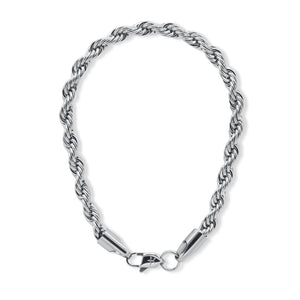
The Essential Rope Bracelet 5mm in silver is a stainless-steel chain bracelet built in a rope-chain style. A rope bracelet belongs to the broader chain bracelet category, where the visual design comes from repeated metal links rather than gemstones, settings, or cast decorative elements. The “5mm” measurement refers to the approximate chain width, placing it in a medium-width range that is visible on the wrist without having the mass of a heavy curb, Cuban, or box-link bracelet.
A rope chain is constructed from small metal links arranged in a twisted, helical pattern that resembles two strands of rope wound together. This structure creates alternating raised and recessed surfaces, so the bracelet reflects light from multiple angles as the wrist moves. Unlike a flat link chain, a rope chain has a rounded profile and textured surface, which gives it more visual depth while still remaining flexible enough for daily wear.
The silver color of this bracelet refers to its bright, cool-toned metal appearance rather than to sterling silver content. Because the listed material is stainless steel, the bracelet is not a traditional .925 sterling silver bracelet and does not rely on a silver alloy for its color. Its defining characteristics are the 5mm rope texture, stainless-steel construction, polished silver-tone surface, and adaptable chain-only design that can be worn alone or layered with watches, cuffs, or other bracelets.
---
MATERIAL & CONSTRUCTION
Stainless steel is an iron-based alloy that contains chromium, usually at least about 10.5%, which allows the metal to form a thin chromium oxide layer on its surface. This passive oxide layer is what gives stainless steel its corrosion resistance; when scratched lightly, the layer can reform in the presence of oxygen. Jewelry-grade stainless steel is commonly made from 304 or 316L stainless steel, although the exact grade should be confirmed by the seller if a customer has nickel sensitivity or specific alloy requirements. 316L stainless steel is widely used in body jewelry and watches because its lower carbon content and molybdenum addition improve resistance to certain forms of corrosion, especially in chloride-rich environments.
A stainless-steel rope bracelet differs materially from sterling silver, silver-plated brass, and white gold. Sterling silver is 92.5% silver alloyed with other metals, usually copper, and can tarnish when sulfur compounds in air react with silver to form silver sulfide. Stainless steel does not tarnish in the same way because it does not rely on silver content, though it can accumulate surface residue, scratches, or discoloration from chemicals. In a rope-chain construction, the bracelet’s durability depends not only on the alloy but also on link thickness, soldering or closure quality, and how much lateral stress the twisted link pattern receives during wear.
---
FREQUENTLY ASKED QUESTIONS
Q: Is a stainless-steel rope bracelet better than a sterling silver rope bracelet?
A: Stainless steel and sterling silver have different advantages, so one is not universally “better.” Stainless steel is generally harder, more scratch-resistant, and more resistant to tarnish than sterling silver, making it practical for frequent wear. Sterling silver has intrinsic precious-metal value and a warmer white-metal appearance, but it is softer and will usually require more polishing over time because it reacts with sulfur compounds in the environment. A stainless-steel rope bracelet is often chosen for durability and low maintenance, while a sterling silver rope bracelet is chosen by customers who prioritize precious-metal content and traditional jewelry metallurgy.
Q: What does 5mm mean on a rope bracelet, and is that considered thick?
A: The 5mm measurement refers to the approximate width or diameter of the rope chain when viewed across the wrist. In bracelet sizing, 5mm is usually considered a medium width: substantial enough to show the twisted rope texture clearly, but not as heavy-looking as an 8mm, 10mm, or larger chain. Rope chains appear visually fuller than some flat chains of the same width because their rounded profile reflects light around the entire circumference. For most wrists, a 5mm rope bracelet works as a standalone chain or as part of a stack without visually overpowering nearby pieces.
Q: How durable is a rope-chain bracelet for everyday wear?
A: A rope-chain bracelet can be durable for everyday wear when the links are well formed and the clasp is properly matched to the chain weight. The twisted construction distributes visual texture around the chain, but it also means the bracelet contains many small link contact points that can collect dirt or experience friction. Stainless steel improves practical durability because it is harder than sterling silver and resists corrosion under normal conditions. However, no chain bracelet is indestructible; pulling, snagging, bending the chain sharply, or wearing it during heavy labor can stress the links and clasp over time.
Q: Will the silver color wear off on a stainless-steel bracelet?
A: If the bracelet is solid stainless steel with a natural polished silver-tone finish, the color is not a separate silver plating layer and should not “wear off” in the way plated jewelry can. Stainless steel is naturally gray-silver in color because of its alloy composition and surface finish. If a stainless-steel bracelet has an additional coating, such as a bright polish, rhodium-tone finish, or PVD layer, then surface appearance may depend on that treatment, but the underlying metal remains stainless steel. The product should be evaluated by its disclosed material and finish rather than by color alone, because “silver” can describe either metal content or appearance depending on the listing.
Q: Why does a rope bracelet catch light differently from a curb or Figaro bracelet?
A: A rope bracelet reflects light differently because its links are arranged in a spiral pattern with many curved surfaces facing different directions. A curb chain has flatter, interlocking links that tend to reflect light in broader flashes from aligned planes. A Figaro chain alternates link lengths, creating a patterned rhythm, but it usually has less continuous all-around texture than a rope chain. The Essential Rope Bracelet’s 5mm rounded rope structure produces smaller, frequent highlights across the surface, which makes the chain look textured and dimensional even without stones or engraving.
Q: Is a stainless-steel bracelet a good value compared with gold or silver jewelry?
A: Stainless steel can offer strong functional value because it provides corrosion resistance, hardness, and low maintenance at a lower material cost than precious metals. Gold and sterling silver have recognized intrinsic metal value, while stainless steel’s value is more closely tied to engineering performance, manufacturing quality, design, and finish. A stainless-steel bracelet will not carry the same melt value or traditional precious-metal status as gold or silver, but it may outperform them in scratch resistance and tarnish resistance for daily use. For buyers comparing value, the key question is whether they prioritize precious-metal content or practical wear characteristics.
---
CARE & MAINTENANCE
Clean a stainless-steel rope bracelet with warm water, mild dish soap, and a soft toothbrush or microfiber cloth, paying attention to the recessed areas between the twisted rope links where sweat, lotion, and dust can collect. Rinse thoroughly and dry completely, because trapped moisture and residue can dull the surface even when the alloy itself is corrosion resistant. Avoid chlorine bleach, pool chemicals, strong acids, and abrasive polishing compounds, because chlorides and harsh chemicals can damage the passive chromium oxide layer or leave surface staining under certain conditions. Remove the bracelet before heavy lifting, contact sports, or work involving tools, since physical impact and snagging are more likely to deform links or stress the clasp than ordinary daily wear.