Product Knowledge Base
+
Essential Rope Bracelet 4mm (Silver) — Complete Product Guide
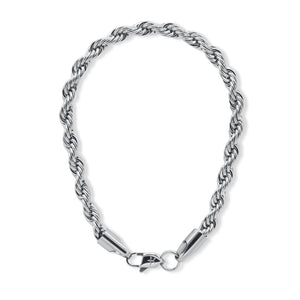
The Essential Rope Bracelet 4mm (Silver) is a stainless-steel wrist bracelet made in a rope-chain style with a silver-tone finish. It belongs to the bracelet category of chain jewelry, specifically a flexible link bracelet designed for daily wear. The 4mm measurement refers to the approximate visual width of the chain, placing it in a medium-width range: substantial enough to show texture on the wrist, but not as heavy or visually dominant as wider curb, Cuban, or box-chain bracelets.
A rope bracelet is constructed from repeating metal link segments arranged in a twisted pattern that resembles strands of rope. Unlike a flat curb chain, which lies in broad interlocking planes, a rope chain has a rounded or semi-rounded profile with diagonal ridges that catch light from multiple angles. This construction creates a textured surface and a continuous spiral appearance, which is why rope chains often look brighter than smoother chain styles of the same metal color.
The defining visual feature of this bracelet is its silver-colored, high-reflective rope texture. The 4mm diameter gives the bracelet enough thickness for the twisted pattern to be visible without making the bracelet overly bulky. Structurally, rope chains are flexible because they are made from many small repeating components, but their textured geometry also means dirt, oils, and abrasion can accumulate in the grooves more readily than on a plain polished bangle or flat chain.
---
MATERIAL & CONSTRUCTION
This bracelet is made from stainless steel, a corrosion-resistant iron-based alloy containing chromium. Stainless steel resists rust because chromium in the alloy reacts with oxygen to form a thin, transparent chromium oxide layer on the surface. This passive oxide film helps protect the underlying metal from oxidation, moisture, and many common environmental exposures. Jewelry-grade stainless steel is often made from grades such as 304 or 316L, although the exact alloy grade should be confirmed by the seller if a customer needs that specification for allergy or technical reasons.
Stainless steel differs from sterling silver because it is not a precious metal alloy and does not contain 92.5% silver. Its silver color comes from the metal’s natural polished surface, not from a thick layer of silver plating. Stainless steel is generally harder and more scratch-resistant than sterling silver, and it does not tarnish in the same sulfur-driven way that silver does. However, stainless steel can still show surface scratches, polish wear, or residue buildup over time, especially on textured chain styles like rope bracelets.
---
FREQUENTLY ASKED QUESTIONS
Q: Is a stainless-steel rope bracelet better than a sterling silver rope bracelet?
A: Stainless steel and sterling silver have different strengths, so one is not universally “better” than the other. Stainless steel is typically harder, more resistant to dents, and less reactive to moisture than sterling silver, making it practical for frequent wear. Sterling silver is a precious metal alloy made of 92.5% silver and 7.5% other metals, usually copper, and it can develop tarnish when exposed to sulfur compounds in air, skin products, or storage materials. Stainless steel does not have the same precious-metal value as sterling silver, but it usually requires less polishing and is more resistant to everyday corrosion.
Q: What does a 4mm rope bracelet look like on the wrist?
A: A 4mm rope bracelet has a medium visual presence that is noticeable without being extremely heavy or oversized. The rope pattern creates diagonal ridges and shadows, so the bracelet may appear more dimensional than a smooth chain of similar width. On most wrists, 4mm is wide enough to wear alone as a simple chain bracelet, but it is also narrow enough to stack with a watch, cuff, or other bracelets. The silver-tone surface emphasizes the twisted texture because the raised areas reflect light while the recessed grooves appear slightly darker.
Q: Is stainless steel good for an everyday bracelet?
A: Stainless steel is well suited to everyday bracelets because it has strong resistance to corrosion, moisture, and general wear. Its chromium oxide surface layer helps protect the metal from rusting under normal conditions. Compared with softer metals such as sterling silver or high-karat gold, stainless steel is less prone to bending and deep scratching, although it is not completely scratch-proof. A rope bracelet also has many small surfaces and edges, so normal wear can gradually create fine marks on the raised portions of the chain.
Q: Will a silver stainless-steel bracelet tarnish or fade?
A: Stainless steel does not tarnish like sterling silver because it does not rely on exposed silver that can react with sulfur to form dark silver sulfide. The silver appearance of stainless steel is generally the natural color of the polished alloy rather than a temporary anti-tarnish coating. If the bracelet has any additional surface finishing or plating, that layer may wear differently, but untreated stainless steel itself is highly color-stable. Discoloration that appears on stainless steel jewelry is often residue from lotions, soaps, minerals, or environmental films rather than true metal tarnish.
Q: How durable is a rope-chain bracelet compared with other chain styles?
A: Rope chains are flexible and visually textured, but their durability depends on link thickness, manufacturing quality, and how much stress is placed on the chain. A 4mm rope bracelet has more material than a very thin chain, which generally improves resistance to deformation and breakage. However, rope chains have many interlocking components, so they should not be pulled, twisted sharply, or caught on hard objects because localized force can distort the link pattern. Compared with a solid bangle, a rope chain is more flexible; compared with a very flat chain, it has more raised surfaces that can experience abrasion.
Q: Is a stainless-steel bracelet a good value compared with silver or gold?
A: Stainless steel bracelets usually offer strong practical value because the material is durable, corrosion-resistant, and less expensive than precious metals. The lower cost is mainly because stainless steel is an industrial alloy rather than a precious metal with commodity value like gold, platinum, or silver. A stainless-steel bracelet should be evaluated for construction quality, finishing, clasp security, comfort, and link consistency rather than metal resale value. For someone who prioritizes wear resistance and low maintenance over precious-metal content, stainless steel can be a logical choice.
---
CARE & MAINTENANCE
Clean a stainless-steel rope bracelet with warm water, mild dish soap, and a soft brush to reach the grooves between the twisted links. Rinse thoroughly and dry completely with a soft cloth, because trapped soap, minerals, or skin oils can dull the reflective surface and collect in the recessed rope texture. Avoid chlorine bleach, harsh acids, abrasive powders, and rough polishing pads, because strong chemicals can disrupt surface finishes and abrasives can create visible micro-scratches on polished stainless steel. Remove the bracelet before activities that create high impact, heavy abrasion, or snagging forces, because rope-chain links can deform if they are pulled sharply or compressed against hard surfaces.