Product Knowledge Base
+
Diamond Huggie Earrings — Complete Product Guide
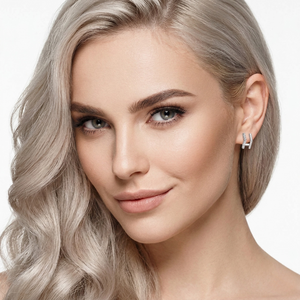
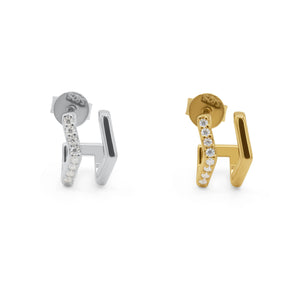
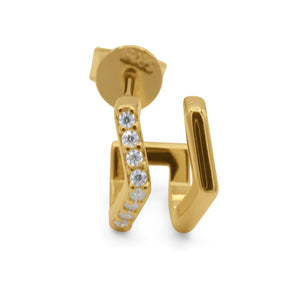
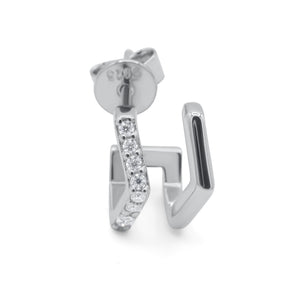
Diamond huggie earrings are small hinged hoop earrings designed to sit close to the earlobe rather than hang below it like a traditional hoop. This product belongs to the huggie earring category, which is defined by a compact circular or semi-circular profile, a hinged post, and a snap-style closure that creates a continuous-looking loop around the piercing. The defining feature of this style is the row of bright white faceted stones set along the visible outer front curve, giving the earring light return from the angle most visible when worn.
This specific earring style is constructed as a close-fitting hoop with a curved metal body, a hinged ear post, and a locking or click-in back mechanism. The stones are arranged in a linear arc across the front-facing surface, typically using small round brilliant-cut stones because that cutting style provides strong sparkle in compact settings. Huggies are structurally different from open hoops because the post is integrated into the hoop and closes into the opposite side, which helps reduce movement and keeps the earring positioned close to the ear.
The visual effect of diamond huggie earrings comes from the contrast between the polished metal frame and the repeated reflections from the stones. Because the hoop diameter is small, the stones appear concentrated rather than widely spaced, creating a clean line of brightness along the lower edge of the earlobe. This makes the design suitable for first piercings, second piercings, and stacked ear arrangements where larger hoops or drop earrings would take up more visual space.
---
MATERIAL & CONSTRUCTION
Diamond huggie earrings may be made in yellow-gold-tone, white-metal, sterling silver, solid gold, gold-plated, or vermeil constructions depending on the specific variant. If the base metal is sterling silver, the industry standard is .925 silver, meaning the alloy contains 92.5% silver and 7.5% other metals, usually copper, to improve hardness. Pure silver is too soft for most earring mechanisms, so copper is added for strength, but copper also contributes to tarnish when the metal reacts with sulfur compounds in air, cosmetics, or humidity.
If the earrings are made in gold, the karat mark identifies the proportion of pure gold in the alloy. For example, 14 karat gold is 14 parts gold out of 24, or 58.3% pure gold, with the remaining alloy made from metals such as silver, copper, zinc, palladium, or nickel-free white alloys depending on color and manufacturing standard. If the stones are moissanite rather than mined diamond, they are silicon carbide crystals grown in a laboratory and cut to resemble diamond; moissanite is not chemically diamond, but it is highly durable at 9.25 on the Mohs hardness scale and has a higher refractive index than diamond, which gives it strong rainbow-like dispersion.
---
FREQUENTLY ASKED QUESTIONS
Q: Are diamond huggie earrings the same as regular hoop earrings?
A: Diamond huggie earrings are a specific type of hoop earring, but they are smaller and more fitted than a standard hoop. A traditional hoop may hang below the earlobe and move freely, while a huggie is designed to closely encircle the lobe with minimal empty space. The construction usually includes a hinged post that clicks into the opposite side of the hoop, creating a secure closed shape. The stone-set front surface also distinguishes diamond huggies from plain metal hoops because the visible face is engineered for light reflection rather than only metal shine.
Q: What is the difference between diamond, moissanite, and cubic zirconia in huggie earrings?
A: Diamond is crystalline carbon and has a Mohs hardness of 10, making it the hardest common gemstone used in jewelry. Moissanite is silicon carbide and measures about 9.25 on the Mohs scale, so it is also highly resistant to scratching in everyday wear. Cubic zirconia is zirconium dioxide and is softer, usually around 8 to 8.5, which means its facet edges can abrade more quickly over time. Visually, moissanite often shows more rainbow dispersion than diamond, while diamond tends to show a balance of white brilliance and fire depending on cut quality.
Q: Are huggie earrings secure enough for daily wear?
A: Huggie earrings are generally well suited for daily wear because the hinge-and-click mechanism keeps the post enclosed inside the hoop structure. The most important durability point is the closure tension: a good huggie should produce a distinct click when closed and should not open with light pressure. The hinge is a moving mechanical component, so it can loosen if the earring is bent, pulled, or repeatedly forced open beyond its normal range. For stone-set huggies, the wearer should also periodically inspect the settings to make sure no prongs or channels have lifted.
Q: Is sterling silver or gold better for diamond huggie earrings?
A: Sterling silver and gold both work for huggie earrings, but they behave differently over time. Sterling silver is more affordable and has a bright white appearance, but it can tarnish because silver reacts with sulfur-containing compounds in the environment to form silver sulfide on the surface. Solid gold is more resistant to tarnish and corrosion, especially at 14 karat or 18 karat purity, but it costs more because of its gold content. Gold-plated or vermeil styles can provide a gold appearance over a different base metal, but the surface layer can wear down with friction, sweat, and chemical exposure.
Q: Why do diamond huggie earrings look smaller on some ears than others?
A: The appearance of huggie earrings depends heavily on hoop inner diameter, earlobe thickness, and piercing placement. A huggie with the same millimeter measurement can sit tightly on a low or thin lobe but appear very close or difficult to close on a thicker lobe or a piercing placed higher from the edge. The defining style of this product is a close-to-the-ear fit, so it is intentionally more compact than a medium hoop. The row of stones on the front curve is designed to remain visible even when the hoop diameter is small, which is why the sparkle appears concentrated rather than spread out.
Q: Are diamond or moissanite huggie earrings a good value compared with larger diamond hoops?
A: Huggie earrings often provide strong visual impact with less total stone weight than larger hoop earrings because the stones are concentrated on the front-facing portion. In many hoop designs, stones set around the full outside circumference increase cost but may not all be visible from the front when worn. A front-set huggie uses material efficiently because the gemstones are placed where they catch light and where the viewer sees them most directly. If the stones are moissanite, the cost is usually lower than diamond of comparable size and appearance, while still offering high hardness and strong brilliance for everyday jewelry.
---
CARE & MAINTENANCE
Clean diamond or moissanite huggie earrings with lukewarm water, mild dish soap, and a soft brush, paying special attention to the underside of the stones where skin oils and lotion can collect and reduce light return. Avoid chlorine, bleach, perfume, hairspray, and harsh jewelry dips because chemicals can attack plating, accelerate tarnish on sterling silver, or leave residues around small settings and hinges. Dry the earrings completely before storage because moisture can encourage tarnish on silver alloys and can leave mineral deposits in hinge joints. Store huggies separately in a soft pouch or lined compartment to prevent harder stones from scratching softer metals and to protect the hinge and closure from bending under pressure.