Product Knowledge Base
+
Classic Pearl Necklace — Complete Product Guide
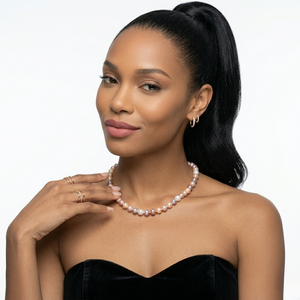
A Classic Pearl Necklace belongs to the pearl strand necklace category, a jewelry format in which pearls—not metal links or a pendant—form the primary visible structure of the piece. Unlike a chain necklace, where visual interest comes from link geometry such as cable, curb, rope, or box links, a pearl necklace is defined by the sequence, shape, surface quality, luster, and matching of the pearls. The “classic” pearl necklace silhouette usually refers to a single strand of pearls worn close to the collarbone or upper chest, designed to present a continuous, symmetrical line around the neck.
A pearl necklace is typically constructed from individually drilled pearls strung on silk, nylon, or a synthetic beading cord and finished with a clasp. In traditional fine-jewelry construction, knots may be placed between pearls to reduce abrasion, preserve spacing, and prevent the full strand from scattering if the cord breaks. The defining visual characteristics of this piece are the soft, rounded pearl surfaces, subtle reflective glow, and formal simplicity associated with a uniform pearl strand rather than a pendant, charm, or gemstone station necklace.
A classic pearl necklace is structurally different from most everyday metal necklaces because pearls are organic gemstones with a layered nacre surface. Their beauty depends less on faceting or high refractive sparkle and more on luster, orient, surface cleanliness, roundness, and consistency from pearl to pearl. This makes the necklace visually quiet but technically dependent on careful matching, secure stringing, and appropriate care.
---
MATERIAL & CONSTRUCTION
Pearls are organic gemstones formed when a mollusk deposits nacre around an internal nucleus or irritant. Nacre is composed primarily of aragonite, a crystalline form of calcium carbonate, bound together by conchiolin, an organic protein matrix. This layered structure gives pearls their characteristic glow, because light enters the nacre, reflects across microscopic layers, and returns with a soft internal sheen rather than the sharp brilliance seen in faceted diamonds or sapphires. Most pearls used in modern jewelry are cultured pearls, meaning human intervention starts the formation process while the mollusk still creates the nacre.
The construction quality of a pearl necklace depends on more than the pearls themselves. Important technical details include the pearl type, diameter, shape consistency, nacre thickness, surface blemishing, drill-hole quality, cord material, knotting method, clasp metal, and clasp security. A well-made pearl necklace should have pearls aligned so the most visible surfaces face outward, drill holes should be clean rather than chipped, and the strand should drape smoothly without kinks. Because pearls are softer than most gemstones, the stringing method and finishing components play a major role in long-term durability.
---
FREQUENTLY ASKED QUESTIONS
Q: What is the difference between a pearl necklace and a gold or silver chain necklace?
A: A pearl necklace is built around organic gemstone beads, while a gold or silver chain necklace is built from connected metal links. Pearls are softer and more chemically sensitive than precious metals, so they require gentler care and should not be treated like a standard chain. A metal chain’s durability depends mostly on alloy, link thickness, soldering, and clasp construction, while a pearl necklace’s durability depends on nacre condition, drill holes, stringing material, knots, and clasp attachment. Visually, pearls create a soft, diffused glow, whereas polished metal creates sharper reflections and more linear shine.
Q: Are cultured pearls real pearls?
A: Cultured pearls are real pearls because they are produced by mollusks using nacre, the same biological material found in natural pearls. The difference is how the formation begins: natural pearls form without human initiation, while cultured pearls begin when a technician introduces a nucleus or tissue graft into the mollusk. Chemically and structurally, cultured pearls are still composed of calcium carbonate and conchiolin. Most pearl jewelry sold today uses cultured pearls because natural pearls are extremely rare, difficult to match, and often far more expensive.
Q: How is a classic pearl necklace usually constructed?
A: A classic pearl necklace is usually made by drilling each pearl and stringing the pearls in sequence on silk, nylon, or another specialized jewelry cord. Higher-quality strand construction often includes knots between pearls, which reduce pearl-to-pearl rubbing and help keep the necklace from completely coming apart if the cord breaks. The strand is then attached to a clasp, commonly using metal findings and reinforced end knots or bead tips. Proper construction should allow the necklace to drape fluidly while keeping the pearls evenly spaced and visually aligned.
Q: How durable is a pearl necklace for everyday wear?
A: Pearls can be worn regularly, but they are not as hard or abrasion-resistant as diamonds, sapphires, rubies, or many metal surfaces. On the Mohs hardness scale, pearls generally fall around 2.5 to 4.5, which means they can be scratched by harder materials and damaged by rough handling. Their nacre can also react poorly to acids, alcohols, perfumes, hairspray, and harsh cleaners because calcium carbonate is chemically vulnerable to acidic substances. For everyday wear, a pearl necklace is best put on after cosmetics and removed before bathing, swimming, exercising, or sleeping.
Q: What affects the value of a pearl necklace?
A: The value of a pearl necklace is influenced by pearl type, size, luster, surface quality, shape, color, nacre thickness, and how well the pearls are matched across the strand. Luster is especially important because it reflects the quality and arrangement of nacre layers; sharper, deeper reflection usually indicates better nacre quality. Round pearls are often valued more highly than off-round pearls when other factors are equal, because consistent roundness is harder to achieve. Construction also matters: secure knotting, clean drill holes, appropriate clasp materials, and balanced strand graduation all contribute to practical and appraisal value.
Q: What makes this Classic Pearl Necklace visually different from trend-based necklace styles?
A: This Classic Pearl Necklace is visually defined by a continuous pearl presentation rather than a pendant focal point, layered chain texture, oversized links, or gemstone stations. The style relies on repetition, symmetry, and the surface glow of the pearls, which gives it a softer appearance than polished metal or faceted stones. Because the pearls form the main design element, the necklace frames the neckline with a rounded, light-reflective line rather than a single central ornament. This makes the piece visually adaptable, but its technical identity remains that of a pearl strand necklace rather than a chain, charm, or pendant necklace.
---
CARE & MAINTENANCE
A pearl necklace should be cleaned with a soft, slightly damp cloth after wearing to remove skin oils, salts, cosmetics, and environmental residue. Avoid ultrasonic cleaners, steam cleaners, bleach, ammonia, vinegar, alcohol, and jewelry dips because pearls contain calcium carbonate and organic binding materials that can be etched, dehydrated, or dulled by harsh chemistry and heat. Perfume, hairspray, sunscreen, and lotion should be applied before the necklace is worn, since these products can leave films on nacre and weaken stringing over time. Store the necklace flat or gently coiled in a soft pouch away from harder gemstones and metal edges, and have the strand inspected periodically for stretched cord, frayed knots, loose clasp connections, or darkened drill holes that may indicate wear.