Product Knowledge Base
+
Aurora Moissanite Eternity Ring — Complete Product Guide
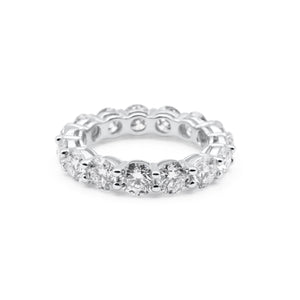
The Aurora Moissanite Eternity Ring is a sterling silver eternity band set with moissanite stones around the circumference of the ring. It belongs to the eternity ring category, a style defined by a continuous or near-continuous sequence of gemstones that symbolically and visually creates an unbroken circle. In practical jewelry terms, an eternity ring is different from a plain band because the stone-setting structure is repeated around the shank, making the entire ring surface more reflective and more structurally complex.
This ring is defined by the contrast between a bright white metal body and high-dispersion moissanite stones. Moissanite has a refractive index of approximately 2.65–2.69, which is higher than diamond’s approximately 2.42, so it bends light strongly and can produce pronounced flashes of white and spectral color. In an eternity layout, each individual stone contributes to the overall light return, so the visual effect comes from repeated small points of brilliance rather than one central focal stone.
Structurally, a moissanite eternity ring requires precise seat cutting and secure stone placement because the stones extend around the band rather than being limited to the top of the finger. The repeated setting pattern must balance visibility, comfort, and durability: the metal must hold each stone securely while keeping the profile wearable for daily hand movement. Because the stones continue around the ring, the underside of the band is also decorative and may contact hard surfaces more often than a plain metal shank.
---
MATERIAL & CONSTRUCTION
Sterling silver is legally and technically defined as an alloy containing 92.5% silver by weight, usually marked “925.” Pure silver is relatively soft for structural jewelry, so sterling silver is commonly alloyed with about 7.5% copper or other strengthening metals to improve hardness, wear resistance, and shape retention. The copper content helps the ring maintain its form, but it also contributes to tarnish behavior because sterling silver reacts with sulfur compounds in air, cosmetics, rubber, and some storage materials to form dark silver sulfide on the surface.
Moissanite is crystalline silicon carbide, not diamond, cubic zirconia, or glass. Most jewelry-grade moissanite is lab-created because natural moissanite is extremely rare and not available in consistent gem sizes for commercial jewelry. Compared with diamond, moissanite has lower hardness but still ranks very high at about 9.25 on the Mohs scale, making it suitable for rings. Its high dispersion, approximately 0.104 compared with diamond’s approximately 0.044, is the reason moissanite can show strong rainbow fire, especially in small repeated stones such as those used in eternity bands.
---
FREQUENTLY ASKED QUESTIONS
Q: Is a sterling silver moissanite eternity ring durable enough for everyday wear?
A: A sterling silver moissanite eternity ring can be worn regularly, but it requires more care than the same design made in platinum or solid gold. Moissanite itself is highly durable for a gemstone, with excellent resistance to scratching compared with quartz, glass, and many colored gemstones. Sterling silver is softer than 14k gold, 18k gold, and platinum, so the metal prongs or stone seats can wear faster over time, especially on the underside of an eternity band. Because stones extend around the ring, the setting is exposed to more impact from gripping objects, steering wheels, gym equipment, desks, and countertops.
Q: How does moissanite compare with diamond in an eternity ring?
A: Moissanite and diamond are different materials with different optical and physical properties. Diamond is carbon with a Mohs hardness of 10, while moissanite is silicon carbide with a Mohs hardness of about 9.25, so diamond is more scratch-resistant but moissanite is still very hard for jewelry use. Moissanite has higher dispersion than diamond, which means it often shows more rainbow-colored fire, especially under direct or point-source lighting. In an eternity ring, where many small stones are arranged side by side, moissanite can create a very lively surface appearance, while diamond typically gives a sharper white brilliance and less spectral color.
Q: What does “eternity ring” mean, and how is it different from a regular band?
A: An eternity ring is a band set with gemstones around the ring, traditionally forming a continuous circle of stones. A regular plain band relies primarily on metal shape, width, and finish for its appearance, while an eternity band depends on repeated gemstone setting and light reflection. Full eternity rings have stones all the way around the circumference; partial or half eternity rings have stones only across the visible top portion. A full eternity construction is visually continuous but can be more difficult or sometimes impossible to resize because removing or adding metal would disrupt the stone pattern.
Q: Is sterling silver better than gold or platinum for a moissanite eternity ring?
A: Sterling silver is not “better” or “worse” in every case; it is a different material with different tradeoffs. Sterling silver is bright, accessible, and visually compatible with colorless or near-colorless moissanite, but it is softer and more tarnish-prone than gold or platinum. Gold alloys, especially 14k gold, generally provide better long-term prong strength and resistance to deformation, while platinum is dense, tough, and often used for high-wear settings. For a moissanite eternity ring, sterling silver is best understood as a bright white precious-metal option that needs more maintenance and periodic setting inspection than harder or denser metals.
Q: Why does this ring look so bright and reflective compared with a plain silver ring?
A: The Aurora Moissanite Eternity Ring looks brighter than a plain silver band because it combines two reflective systems: polished sterling silver and multiple faceted moissanite stones. A plain silver ring reflects light mostly from its metal surface, while an eternity ring reflects and refracts light through many individual gemstones. Moissanite’s high refractive index increases internal light bending, and its high dispersion separates light into visible spectral flashes more strongly than many common gemstones. The eternity layout also means that light return is distributed around the band, so movement of the hand produces repeated sparkle rather than a single flash from one central stone.
Q: Is a moissanite eternity ring a good value compared with a diamond eternity ring?
A: A moissanite eternity ring usually costs less than a comparable diamond eternity ring because lab-created moissanite is less expensive per carat than natural or lab-grown diamond. The value comparison depends on what the buyer prioritizes: diamond offers the traditional diamond material identity, maximum hardness, and established resale recognition, while moissanite offers strong brilliance and fire at a lower material cost. In small eternity-band stones, moissanite can provide a highly reflective look without requiring the budget of a full diamond eternity band. However, long-term value should also include the metal setting, because sterling silver may need more maintenance than gold or platinum over years of wear.
---
CARE & MAINTENANCE
Clean a sterling silver moissanite eternity ring with warm water, mild dish soap, and a soft brush, paying special attention to the spaces around the stones where lotion, soap residue, and skin oils can collect. Avoid chlorine bleach, sulfur-rich environments, rubber storage materials, and harsh silver dips, because chemicals can accelerate tarnish or affect darkened areas around settings. Remove the ring before weightlifting, gardening, cleaning, swimming, or handling abrasive materials, since sterling silver can scratch or deform and an eternity setting exposes stones around the entire band. Store the ring dry in an anti-tarnish pouch or lined jewelry box, and have the stone settings inspected periodically because small prongs or shared setting points can loosen through repeated impact and wear.